| Near-side and away-side jet fragments as a function of multiplicity class with the Pythia8 description.
|

|
| Near-side jet fragments as a function of multiplicity class with model descriptions
|

|
| Near-side $\Delta\eta$ projections for various transverse momentum ranges in high-multiplicity and minimum bias pp collisions at 13 TeV with model descriptions,
|

|
| v3 as a function of event-scale selection in high-multiplicity(0--0.1%) pp collisions at 13 TeV using template fit
|

|
| v2 as a function of event-scale selection in high-multiplicity(0--0.1%) pp collisions at 13 TeV using template fit
|

|
| v2 and v3 as a function of transverse momentum in high-multiplicity(0--0.1%) pp collisions at 13 TeV using template fit
|

|
| Flow extraction using the template fit in high-multiplicity(0--0.1%) pp collisions at 13 TeV for 1$~<p_{\rm{T}}<~$2 GeV/$c$
|

|
| Centrality dependence of the flow angle and magnitude fluctuations from v2{2}/v2[2]
|

|
| Lower and upper limits of flow angle and flow magnitude fluctuations of v2{2}/v2[2] with etagap > 0.0 in centralities 0-5%, 10-20% and 30-40%
|

|
| Lower and upper limits of flow angle and flow magnitude fluctuations of v2{2}/v2[2] with etagap > 0.0 in centralities 0-5%, 5-10%, 10-20%, 20-30%, 30-40% and 40-50%
|

|
| <v2(pt)^2 v2^2>/<v2(pt)^2><v2^2> with etagap > 0.0 in centralities 0-5%, 10-20% and 30-40%
|

|
| <v2(pt)^2 v2^2>/<v2(pt)^2><v2^2> with etagap > 0.0 in centralities 0-5%, 5-10%, 10-20%, 20-30%, 30-40% and 40-50%
|

|
| F(Psi_2^a,\Psi_2) with etagap > 0.0 in centralities 0-5%, 10-20% and 30-40%
|

|
| F(Psi_2^a,\Psi_2) with etagap > 0.0 in centralities 0-5%, 5-10%, 10-20%, 20-30%, 30-40% and 40-50%
|

|
| Charged particle multiplicity evolution of the azimuthal widths of $G_{2}^{\rm CI}$ in pp collisions at $\sqrt{s} = 7$, p--Pb at $\sqrt{s_{\rm NN}} = 5.02$ and Pb--Pb at $\sqrt{s_{\rm NN}} = 2.76\;\text{TeV}$ compared to model predictions
|

|
| Charged particle multiplicity evolution of the azimuthal widths of $G_{2}^{\rm CD}$ in pp collisions at $\sqrt{s} = 7$, p--Pb at $\sqrt{s_{\rm NN}} = 5.02$ and Pb--Pb at $\sqrt{s_{\rm NN}} = 2.76\;\text{TeV}$ compared to model predictions
|

|
| Charged particle multiplicity evolution of the longitudinal widths of $G_{2}^{\rm CI}$ in pp collisions at $\sqrt{s} = 7$, p--Pb at $\sqrt{s_{\rm NN}} = 5.02$ and Pb--Pb at $\sqrt{s_{\rm NN}} = 2.76\;\text{TeV}$ compared to model predictions
|

|
| Charged particle multiplicity evolution of the longitudinal widths of $G_{2}^{\rm CD}$ in pp collisions at $\sqrt{s} = 7$, p--Pb at $\sqrt{s_{\rm NN}} = 5.02$ and Pb--Pb at $\sqrt{s_{\rm NN}} = 2.76\;\text{TeV}$ compared to model predictions
|

|
| Azimuthal projection of the two-particle transverse momentum correlation $G_{2}^{\rm CI}$ from 70--80% multiplicity class pp collisions at $\sqrt{s} = 7\;\text{TeV}$ compared to models
|

|
| Azimuthal projection of the two-particle transverse momentum correlation $G_{2}^{\rm CI}$ from 30--40% multiplicity class pp collisions at $\sqrt{s} = 7\;\text{TeV}$ compared to models
|

|
| Azimuthal projection of the two-particle transverse momentum correlation $G_{2}^{\rm CI}$ from 0--5% multiplicity class pp collisions at $\sqrt{s} = 7\;\text{TeV}$ compared to models
|

|
| Azimuthal projection of the two-particle transverse momentum correlation $G_{2}^{\rm CD}$ from 70--80% multiplicity class pp collisions at $\sqrt{s} = 7\;\text{TeV}$ compared to models
|

|
| Azimuthal projection of the two-particle transverse momentum correlation $G_{2}^{\rm CD}$ from 30--40% multiplicity class pp collisions at $\sqrt{s} = 7\;\text{TeV}$ compared to models
|

|
| Azimuthal projection of the two-particle transverse momentum correlation $G_{2}^{\rm CD}$ from 0--5% multiplicity class pp collisions at $\sqrt{s} = 7\;\text{TeV}$ compared to models
|

|
| Near side $(|\Delta\varphi|<\pi/2)$ longitudinal projection of the two-particle transverse momentum correlation $G_{2}^{\rm CI}$ from 70--80% multiplicity class pp collisions at $\sqrt{s} = 7\;\text{TeV}$ compared to models
|

|
| Near side $(|\Delta\varphi|<\pi/2)$ longitudinal projection of the two-particle transverse momentum correlation $G_{2}^{\rm CI}$ from 30--40% multiplicity class pp collisions at $\sqrt{s} = 7\;\text{TeV}$ compared to models
|

|
| Near side $(|\Delta\varphi|<\pi/2)$ longitudinal projection of the two-particle transverse momentum correlation $G_{2}^{\rm CI}$ from 0--5% multiplicity class pp collisions at $\sqrt{s} = 7\;\text{TeV}$ compared to models
|

|
| Near side $(|\Delta\varphi|<\pi/2)$ longitudinal projection of the two-particle transverse momentum correlation $G_{2}^{\rm CD}$ from 70--80% multiplicity class pp collisions at $\sqrt{s} = 7\;\text{TeV}$ compared to models
|

|
| Near side $(|\Delta\varphi|<\pi/2)$ longitudinal projection of the two-particle transverse momentum correlation $G_{2}^{\rm CD}$ from 30--40% multiplicity class pp collisions at $\sqrt{s} = 7\;\text{TeV}$ compared to models
|

|
| Near side $(|\Delta\varphi|<\pi/2)$ longitudinal projection of the two-particle transverse momentum correlation $G_{2}^{\rm CD}$ from 0--5% multiplicity class pp collisions at $\sqrt{s} = 7\;\text{TeV}$ compared to models
|

|
| Azimuthal projection of the two-particle transverse momentum correlation $G_{2}^{\rm CI}$ from 70--80% multiplicity class p--Pb collisions at $\sqrt{s_{\rm NN}} = 5.02\;\text{TeV}$ compared to models
|

|
| Azimuthal projection of the two-particle transverse momentum correlation $G_{2}^{\rm CI}$ from 30--40% multiplicity class p--Pb collisions at $\sqrt{s_{\rm NN}} = 5.02\;\text{TeV}$ compared to models
|

|
| Azimuthal projection of the two-particle transverse momentum correlation $G_{2}^{\rm CI}$ from 0--5% multiplicity class p--Pb collisions at $\sqrt{s_{\rm NN}} = 5.02\;\text{TeV}$ compared to models
|

|
| Azimuthal projection of the two-particle transverse momentum correlation $G_{2}^{\rm CD}$ from 70--80% multiplicity class p--Pb collisions at $\sqrt{s_{\rm NN}} = 5.02\;\text{TeV}$ compared to models
|

|
| Azimuthal projection of the two-particle transverse momentum correlation $G_{2}^{\rm CD}$ from 30--40% multiplicity class p--Pb collisions at $\sqrt{s_{\rm NN}} = 5.02\;\text{TeV}$ compared to models
|

|
| Azimuthal projection of the two-particle transverse momentum correlation $G_{2}^{\rm CD}$ from 0--5% multiplicity class p--Pb collisions at $\sqrt{s_{\rm NN}} = 5.02\;\text{TeV}$ compared to models
|

|
| Near side $(|\Delta\varphi|<\pi/2)$ longitudinal projection of the two-particle transverse momentum correlation $G_{2}^{\rm CI}$ from 70--80% multiplicity class p--Pb collisions at $\sqrt{s_{\rm NN}} = 5.02\;\text{TeV}$ compared to models
|

|
| Near side $(|\Delta\varphi|<\pi/2)$ longitudinal projection of the two-particle transverse momentum correlation $G_{2}^{\rm CI}$ from 30--40% multiplicity class p--Pb collisions at $\sqrt{s_{\rm NN}} = 5.02\;\text{TeV}$ compared to models
|

|
| Near side $(|\Delta\varphi|<\pi/2)$ longitudinal projection of the two-particle transverse momentum correlation $G_{2}^{\rm CI}$ from 0--5% multiplicity class p--Pb collisions at $\sqrt{s_{\rm NN}} = 5.02\;\text{TeV}$ compared to models
|

|
| Near side $(|\Delta\varphi|<\pi/2)$ longitudinal projection of the two-particle transverse momentum correlation $G_{2}^{\rm CD}$ from 70--80% multiplicity class p--Pb collisions at $\sqrt{s_{\rm NN}} = 5.02\;\text{TeV}$ compared to models
|

|
| Near side $(|\Delta\varphi|<\pi/2)$ longitudinal projection of the two-particle transverse momentum correlation $G_{2}^{\rm CD}$ from 30--40% multiplicity class p--Pb collisions at $\sqrt{s_{\rm NN}} = 5.02\;\text{TeV}$ compared to models
|

|
| Near side $(|\Delta\varphi|<\pi/2)$ longitudinal projection of the two-particle transverse momentum correlation $G_{2}^{\rm CD}$ from 0--5% multiplicity class p--Pb collisions at $\sqrt{s_{\rm NN}} = 5.02\;\text{TeV}$ compared to models
|

|
| Azimuthal projections of the two-particle transverse momentum correlation $G_{2}^{\rm CI}$ from pp collisions at $\sqrt{s} = 7\;\text{TeV}$
|

|
| Azimuthal projections of the two-particle transverse momentum correlation $G_{2}^{\rm CD}$ from pp collisions at $\sqrt{s} = 7\;\text{TeV}$
|

|
| Near side $(|\Delta\varphi|<\pi/2)$ longitudinal projections of the two-particle transverse momentum correlation $G_{2}^{\rm CI}$ from pp collisions at $\sqrt{s} = 7\;\text{TeV}$
|

|
| Near side $(|\Delta\varphi|<\pi/2)$ longitudinal projections of the two-particle transverse momentum correlation $G_{2}^{\rm CD}$ from pp collisions at $\sqrt{s} = 7\;\text{TeV}$
|

|
| Azimuthal projections of the two-particle transverse momentum correlation $G_{2}^{\rm CI}$ from p--Pb collisions at $\sqrt{s_{\rm NN}} = 5.02\;\text{TeV}$
|

|
| Near side $(|\Delta\varphi|<\pi/2)$ longitudinal projections of the two-particle transverse momentum correlation $G_{2}^{\rm CI}$ from p--Pb collisions at $\sqrt{s_{\rm NN}} = 5.02\;\text{TeV}$
|

|
| Azimuthal projections of the two-particle transverse momentum correlation $G_{2}^{\rm CD}$ from p--Pb collisions at $\sqrt{s_{\rm NN}} = 5.02\;\text{TeV}$
|

|
| Near side $(|\Delta\varphi|<\pi/2)$ longitudinal projections of the two-particle transverse momentum correlation $G_{2}^{\rm CD}$ from p--Pb collisions at $\sqrt{s_{\rm NN}} = 5.02\;\text{TeV}$
|

|
| Charged particle multiplicity evolution of the azimuthal widths of $G_{2}^{\rm CI}$ in pp collisions at $\sqrt{s} = 7$, p--Pb at $\sqrt{s_{\rm NN}} = 5.02$ and Pb--Pb at $\sqrt{s_{\rm NN}} = 2.76\;\text{TeV}$ compared to model predictions
|

|
| Charged particle multiplicity evolution of the azimuthal widths of $G_{2}^{\rm CD}$ in pp collisions at $\sqrt{s} = 7$, p--Pb at $\sqrt{s_{\rm NN}} = 5.02$ and Pb--Pb at $\sqrt{s_{\rm NN}} = 2.76\;\text{TeV}$ compared to model predictions
|

|
| Charged particle multiplicity evolution of the longitudinal widths of $G_{2}^{\rm CI}$ in pp collisions at $\sqrt{s} = 7$, p--Pb at $\sqrt{s_{\rm NN}} = 5.02$ and Pb--Pb at $\sqrt{s_{\rm NN}} = 2.76\;\text{TeV}$ compared to model predictions
|

|
| Charged particle multiplicity evolution of the longitudinal widths of $G_{2}^{\rm CD}$ in pp collisions at $\sqrt{s} = 7$, p--Pb at $\sqrt{s_{\rm NN}} = 5.02$ and Pb--Pb at $\sqrt{s_{\rm NN}} = 2.76\;\text{TeV}$ compared to model predictions
|

|
| Charged particle multiplicity evolution of the azimuthal widths of $G_{2}^{\rm CI}$ in pp collisions at $\sqrt{s} = 7$, p--Pb at $\sqrt{s_{\rm NN}} = 5.02$ and Pb--Pb at $\sqrt{s_{\rm NN}} = 2.76\;\text{TeV}$
|

|
| Charged particle multiplicity evolution of the azimuthal widths of $G_{2}^{\rm CD}$ in pp collisions at $\sqrt{s} = 7$, p--Pb at $\sqrt{s_{\rm NN}} = 5.02$ and Pb--Pb at $\sqrt{s_{\rm NN}} = 2.76\;\text{TeV}$
|

|
| Charged particle multiplicity evolution of the longitudinal widths of $G_{2}^{\rm CI}$ in pp collisions at $\sqrt{s} = 7$, p--Pb at $\sqrt{s_{\rm NN}} = 5.02$ and Pb--Pb at $\sqrt{s_{\rm NN}} = 2.76\;\text{TeV}$
|

|
| Charged particle multiplicity evolution of the longitudinal widths of $G_{2}^{\rm CD}$ in pp collisions at $\sqrt{s} = 7$, p--Pb at $\sqrt{s_{\rm NN}} = 5.02$ and Pb--Pb at $\sqrt{s_{\rm NN}} = 2.76\;\text{TeV}$
|

|
| Azimuthal projection of the two-particle transverse momentum correlation $G_{2}^{\rm CI}$ from 70--80% multiplicity class pp collisions at $\sqrt{s} = 7\;\text{TeV}$
|

|
| Azimuthal projection of the two-particle transverse momentum correlation $G_{2}^{\rm CI}$ from 30--40% multiplicity class pp collisions at $\sqrt{s} = 7\;\text{TeV}$
|

|
| Azimuthal projection of the two-particle transverse momentum correlation $G_{2}^{\rm CI}$ from 0--5% multiplicity class pp collisions at $\sqrt{s} = 7\;\text{TeV}$
|

|
| Azimuthal projection of the two-particle transverse momentum correlation $G_{2}^{\rm CD}$ from 70--80% multiplicity class pp collisions at $\sqrt{s} = 7\;\text{TeV}$
|

|
| Azimuthal projection of the two-particle transverse momentum correlation $G_{2}^{\rm CD}$ from 30--40% multiplicity class pp collisions at $\sqrt{s} = 7\;\text{TeV}$
|

|
| Azimuthal projection of the two-particle transverse momentum correlation $G_{2}^{\rm CD}$ from 0--5% multiplicity class pp collisions at $\sqrt{s} = 7\;\text{TeV}$
|

|
| Near side $(|\Delta\varphi|<\pi/2)$ longitudinal projection of the two-particle transverse momentum correlation $G_{2}^{\rm CI}$ from 70--80% multiplicity class pp collisions at $\sqrt{s} = 7\;\text{TeV}$
|

|
| Near side $(|\Delta\varphi|<\pi/2)$ longitudinal projection of the two-particle transverse momentum correlation $G_{2}^{\rm CI}$ from 30--40% multiplicity class pp collisions at $\sqrt{s} = 7\;\text{TeV}$
|

|
| Near side $(|\Delta\varphi|<\pi/2)$ longitudinal projection of the two-particle transverse momentum correlation $G_{2}^{\rm CI}$ from 0--5% multiplicity class pp collisions at $\sqrt{s} = 7\;\text{TeV}$
|

|
| Near side $(|\Delta\varphi|<\pi/2)$ longitudinal projection of the two-particle transverse momentum correlation $G_{2}^{\rm CD}$ from 70--80% multiplicity class pp collisions at $\sqrt{s} = 7\;\text{TeV}$
|

|
| Near side $(|\Delta\varphi|<\pi/2)$ longitudinal projection of the two-particle transverse momentum correlation $G_{2}^{\rm CD}$ from 30--40% multiplicity class pp collisions at $\sqrt{s} = 7\;\text{TeV}$
|

|
| Near side $(|\Delta\varphi|<\pi/2)$ longitudinal projection of the two-particle transverse momentum correlation $G_{2}^{\rm CD}$ from 0--5% multiplicity class pp collisions at $\sqrt{s} = 7\;\text{TeV}$
|

|
| Azimuthal projection of the two-particle transverse momentum correlation $G_{2}^{\rm CI}$ from 70--80% multiplicity class p--Pb collisions at $\sqrt{s_{\rm NN}} = 5.02\;\text{TeV}$
|

|
| Azimuthal projection of the two-particle transverse momentum correlation $G_{2}^{\rm CI}$ from 30--40% multiplicity class p--Pb collisions at $\sqrt{s_{\rm NN}} = 5.02\;\text{TeV}$
|

|
| Azimuthal projection of the two-particle transverse momentum correlation $G_{2}^{\rm CI}$ from 0--5% multiplicity class p--Pb collisions at $\sqrt{s_{\rm NN}} = 5.02\;\text{TeV}$
|

|
| Azimuthal projection of the two-particle transverse momentum correlation $G_{2}^{\rm CD}$ from 70--80% multiplicity class p--Pb collisions at $\sqrt{s_{\rm NN}} = 5.02\;\text{TeV}$
|

|
| Azimuthal projection of the two-particle transverse momentum correlation $G_{2}^{\rm CD}$ from 30--40% multiplicity class p--Pb collisions at $\sqrt{s_{\rm NN}} = 5.02\;\text{TeV}$
|

|
| Azimuthal projection of the two-particle transverse momentum correlation $G_{2}^{\rm CD}$ from 0--5% multiplicity class p--Pb collisions at $\sqrt{s_{\rm NN}} = 5.02\;\text{TeV}$
|

|
| Near side $(|\Delta\varphi|<\pi/2)$ longitudinal projection of the two-particle transverse momentum correlation $G_{2}^{\rm CI}$ from 70--80% multiplicity class p--Pb collisions at $\sqrt{s_{\rm NN}} = 5.02\;\text{TeV}$
|

|
| Near side $(|\Delta\varphi|<\pi/2)$ longitudinal projection of the two-particle transverse momentum correlation $G_{2}^{\rm CI}$ from 30--40% multiplicity class p--Pb collisions at $\sqrt{s_{\rm NN}} = 5.02\;\text{TeV}$
|

|
| Near side $(|\Delta\varphi|<\pi/2)$ longitudinal projection of the two-particle transverse momentum correlation $G_{2}^{\rm CI}$ from 0--5% multiplicity class p--Pb collisions at $\sqrt{s_{\rm NN}} = 5.02\;\text{TeV}$
|

|
| Near side $(|\Delta\varphi|<\pi/2)$ longitudinal projection of the two-particle transverse momentum correlation $G_{2}^{\rm CD}$ from 70--80% multiplicity class p--Pb collisions at $\sqrt{s_{\rm NN}} = 5.02\;\text{TeV}$
|

|
| Near side $(|\Delta\varphi|<\pi/2)$ longitudinal projection of the two-particle transverse momentum correlation $G_{2}^{\rm CD}$ from 30--40% multiplicity class p--Pb collisions at $\sqrt{s_{\rm NN}} = 5.02\;\text{TeV}$
|

|
| Near side $(|\Delta\varphi|<\pi/2)$ longitudinal projection of the two-particle transverse momentum correlation $G_{2}^{\rm CD}$ from 0--5% multiplicity class p--Pb collisions at $\sqrt{s_{\rm NN}} = 5.02\;\text{TeV}$
|

|
| Two-particle transverse momentum correlation $G_{2}^{\rm CI}$ from p--Pb 70--80% multiplicity class collisions at $\sqrt{s_{\rm NN}} = 5.02\;\text{TeV}$
|

|
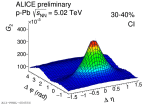
| Two-particle transverse momentum correlation $G_{2}^{\rm CI}$ from p--Pb 30--40% multiplicity class collisions at $\sqrt{s_{\rm NN}} = 5.02\;\text{TeV}$
|
|
| Two-particle transverse momentum correlation $G_{2}^{\rm CI}$ from p--Pb 0--5% multiplicity class collisions at $\sqrt{s_{\rm NN}} = 5.02\;\text{TeV}$
|

|
| Two-particle transverse momentum correlation $G_{2}^{\rm CD}$ from p--Pb 70--80% multiplicity class collisions at $\sqrt{s_{\rm NN}} = 5.02\;\text{TeV}$
|

|
| Two-particle transverse momentum correlation $G_{2}^{\rm CD}$ from p--Pb 30--40% multiplicity class collisions at $\sqrt{s_{\rm NN}} = 5.02\;\text{TeV}$
|

|
| Two-particle transverse momentum correlation $G_{2}^{\rm CD}$ from p--Pb 0--5% multiplicity class collisions at $\sqrt{s_{\rm NN}} = 5.02\;\text{TeV}$
|

|
| Two-particle transverse momentum correlation $G_{2}^{\rm CI}$ from pp 70--80% multiplicity class collisions at $\sqrt{s} = 7\;\text{TeV}$
|

|
| Two-particle transverse momentum correlation $G_{2}^{\rm CI}$ from pp 30--40% multiplicity class collisions at $\sqrt{s} = 7\;\text{TeV}$
|

|
| Two-particle transverse momentum correlation $G_{2}^{\rm CI}$ from pp 0--5% multiplicity class collisions at $\sqrt{s} = 7\;\text{TeV}$
|

|
| Two-particle transverse momentum correlation $G_{2}^{\rm CD}$ from pp 70--80% multiplicity class collisions at $\sqrt{s} = 7\;\text{TeV}$
|

|
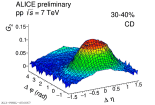
| Two-particle transverse momentum correlation $G_{2}^{\rm CD}$ from pp 30--40% multiplicity class collisions at $\sqrt{s} = 7\;\text{TeV}$
|
|
| Two-particle transverse momentum correlation $G_{2}^{\rm CD}$ from pp 0--5% multiplicity class collisions at $\sqrt{s} = 7\;\text{TeV}$
|

|
| Σ − 1 measured for windows separated in pseudorapidity and azimuth at √s = 0.9 TeV, 1D plots with fixed φₛₑₚ-s
|

|
| Σ − 1 measured for windows separated in pseudorapidity and azimuth at √s = 13 TeV, 1D plots with fixed φₛₑₚ-s
|

|
| Σ − 1 measured for windows separated in pseudorapidity and azimuth at √s = 7 TeV, 1D plots with fixed φₛₑₚ-s
|

|
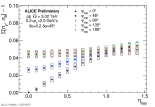
| Σ − 1 measured for windows separated in pseudorapidity and azimuth at √s = 5.02 TeV, 1D plots with fixed φₛₑₚ-s
|
|
| Σ − 1 measured for windows separated in pseudorapidity and azimuth at √s = 2.76 TeV, 1D plots with fixed φₛₑₚ-s
|

|
| Σ − 1 measured for windows separated in pseudorapidity and azimuth at √s = 13 TeV
|

|