| Neutral Pion and Eta Meson Invariant Yield in pPb collisions at 5TeV compared to generators - 0-20% V0A
|

|
| Eta Meson Invariant Yield in pPb collisions at 5TeV - V0A sliced
|

|
| Eta Meson Invariant Yield in pPb collisions at 5TeV - CL1 sliced
|

|
| Eta Meson Invariant Yield in pPb collisions at 5TeV - ZNA sliced
|

|
| Neutral Pion Invariant Yield in pPb collisions at 5TeV - ZNA sliced
|

|
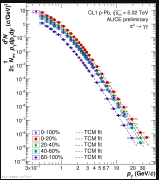
| Neutral Pion Invariant Yield in pPb collisions at 5TeV - CL1 sliced
|
|
| Neutral Pion Invariant Yield in pPb collisions at 5TeV - V0A sliced
|

|
| Dielectron spectrum with cocktail incl EPS09-modified charm
|

|
| Dielectron spectrum with cocktail incl EPPS16-modified charm
|

|
| Dielectron spectrum with cocktail incl binary scaled charm
|

|
RAA comparison of inclusive jpsi->ee at 5 TeV and 2.76 TeV
- Fig. Group : Pb-Pb 5.02 TeV Run 2015
- PWG : PWG-DQ (Dileptons and Quarkonia)
- Energy: 2.76 TeV
, - Energy: 5.02 TeV
- System Pb-Pb
|

|
| K*± /K and K*0/K vs. energy in different collision systems
|

|
| Spectra of Omega for different centrality classes in Xe-Xe collisions at 5.44 TeV
|

|
| Spectra of Xi for different centrality classes in Xe-Xe collisions at 5.44 TeV
|

|
| Spectra of K0S for different centrality classes in Xe-Xe collisions at 5.44 TeV
|

|
| 2D Charged particles Balance Functions in p-Pb collisions at 5.02 TeV - 70-80% (1.0 < pT < 2.0 GeV/c)
|

|
| 2D Charged particles Balance Functions in p-Pb collisions at 5.02 TeV - 70-80% (0.2 < pT < 2.0 GeV/c)
|

|
| 2D Charged particles Balance Functions in p-Pb collisions at 5.02 TeV - 30-40% (1.0 < pT < 2.0 GeV/c)
|

|
| 2D Charged particles Balance Functions in p-Pb collisions at 5.02 TeV - 30-40% (0.2 < pT < 2.0 GeV/c)
|

|
| 2D Charged particles Balance Functions in p-Pb collisions at 5.02 TeV - 0-10% (1.0 < pT < 2.0 GeV/c)
|

|
| 2D Charged particles Balance Functions in p-Pb collisions at 5.02 TeV - 0-10% (0.2 < pT < 2.0 GeV/c)
|

|
| C_4/C_2 of net-proton distributions as a funtion of collision energy
|

|
| C_3/C_2 of net-proton distributions as a funtion of collision energy
|

|
| C_4/C_2 of net-proton distributions vs centrality in Pb-Pb 2.76 TeV and 5.02 TeV
|

|
| C_3/C_2 of net-proton distributions vs centrality in Pb-Pb 2.76 TeV and 5.02 TeV
|

|
| C_4 of net-proton distributions vs centrality in Pb-Pb 2.76 TeV and 5.02 TeV
|

|
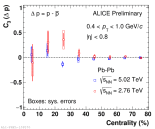
| C_3 of net-proton distributions vs centrality in Pb-Pb 2.76 TeV and 5.02 TeV
|
|
| C_2 of net-proton distributions vs centrality in Pb-Pb 2.76 TeV and 5.02 TeV
|

|
| <pbar> vs centrality in Pb-Pb 2.76 TeV and 5.02 TeV
|

|
| <p> vs centrality in Pb-Pb 2.76 TeV and 5.02 TeV
|

|
| Charged particles Balance Functions RMS DeltaPhi in Pb-Pb vs centrality (comparison Run1 and Run2 energies)
|

|
| Charged particles Balance Functions RMS DeltaEta in Pb-Pb vs centrality (comparison Run1 and Run2 energies)
|

|
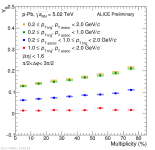
| Charged particles Balance Functions Away side Yields in p-Pb at 5.02 TeV vs centrality (2016 data sample)
|
|
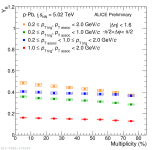
| Charged particles Balance Functions Near Side Yields in p-Pb at 5.02 TeV vs centrality (2016 data sample)
|
|
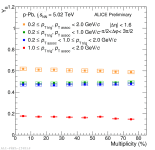
| Charged particles Balance Functions Total Yields in p-Pb at 5.02 TeV vs centrality (2016 data sample)
|
|
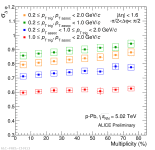
| Charged particles Balance Functions RMS DeltaPhi in p-Pb at 5.02 TeV vs centrality (2016 data sample)
|
|
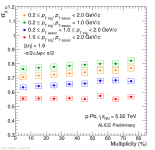
| Charged particles Balance Functions RMS DeltaEta in p-Pb at 5.02 TeV vs centrality (2016 data sample)
|
|
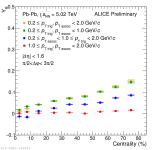
| Charged particles Balance Functions Away Side Yields in Pb-Pb at 5.02 TeV vs centrality
|
|
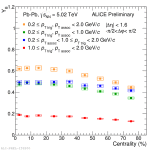
| Charged particles Balance Functions Near Side Yields in Pb-Pb at 5.02 TeV vs centrality
|
|
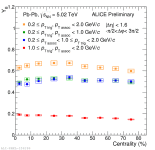
| Charged particles Balance Functions Total Yields in Pb-Pb at 5.02 TeV vs centrality
|
|
| Charged particles Balance Functions RMS DeltaPhi in Pb-Pb at 5.02 TeV vs centrality
|

|
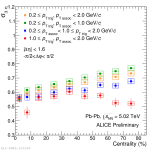
| Charged particles Balance Functions RMS DeltaEta in Pb-Pb at 5.02 TeV vs centrality
|
|
| 2D Charged particles Balance Functions at 5.02 TeV - 70-80% - 1 < pT trigger, pT ass < 2 GeV/c
|

|
| 2D Charged particles Balance Functions at 5.02 TeV - 30-40% - 1 < pT trigger, pT ass < 2 GeV/c
|

|
| 2D Charged particles Balance Functions at 5.02 TeV - 0-5% - 1 < pT trigger, pT ass < 2 GeV/c
|

|
| 2D Charged particles Balance Functions at 5.02 TeV - 70-80%
|

|
| 2D Charged particles Balance Functions at 5.02 TeV - 30-40%
|

|
| 2D Charged particles Balance Functions at 5.02 TeV - 0-5%
|

|
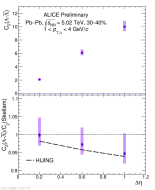
| Net-lambda moments versus DeltaEta in 30-40% central events
|
|
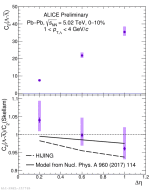
| Net-lambda moments versus DeltaEta in 0-10% central events
|
|
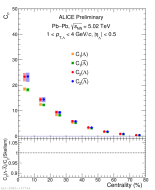
| Net-lambda moments versus centrality, first and second moments only
|
|
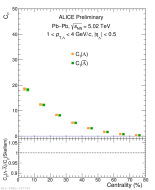
| Net-lambda moments versus centrality, first moments only
|
|
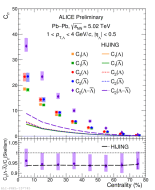
| Net-lambda moments versus centrality, with MC comparison
|
|
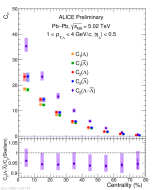
| Net-lambda moments versus centrality
|
|
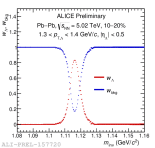
| Example lambda minv weights for Identity Method analysis
|
|
| Example lambda invariant mass peak for Identity Method analysis
|

|
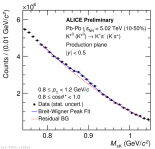
| K*0 signal after background subtraction in Pb-Pb collisions at 5.02 TeV in Production plane
|
|
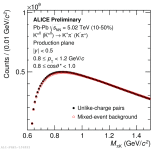
| Invariant mass distribution before background subtraction in Pb-Pb collisions at 5.02 TeV in Production plane
|
|
| v_{2} \{2\} of \Lambda(\bar{\Lambda}) in 0-20\% V0A multiplicity class compared to published CMS
|

|
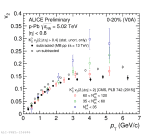
| v_{2} \{2\} of K^{0}_{S} in 0-20\% V0A multiplicity class compared to published CMS
|
|
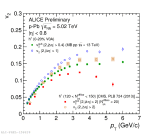
| v_{2} \{2\} of inclusive charged hadrons in 0-20\% V0A multiplicity class compared to published CMS
|
|
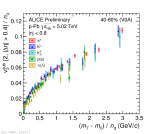
| v_{2}^{sub} \{2,|\Delta\eta| < 0.4\} / n_{q} with KE_{T} scaling in 40-60\% V0A multiplicity class
|
|
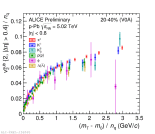
| v_{2}^{sub} \{2,|\Delta\eta| < 0.4\} / n_{q} with KE_{T} scaling in 20-40\% V0A multiplicity class2
|
|
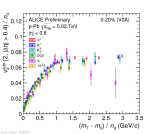
| v_{2}^{sub} \{2,|\Delta\eta| < 0.4\} / n_{q} with KE_{T} scaling in 0-20\% V0A multiplicity class
|
|
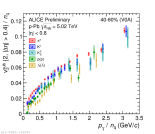
| v_{2}^{sub} \{2,|\Delta\eta| < 0.4\} / n_{q} in 40-60\% V0A multiplicity class
|
|
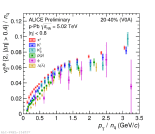
| v_{2}^{sub} \{2,|\Delta\eta| < 0.4\} / n_{q} in 20-40\% V0A multiplicity class
|
|
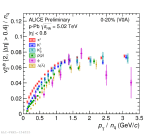
| v_{2}^{sub} \{2,|\Delta\eta| < 0.4\} / n_{q} in 0-20\% V0A multiplicity class
|
|
| v_{2}^{sub} \{2,|\Delta\eta| < 0.4\} in 40-60\% V0A multiplicity class
|

|
| v_{2}^{sub} \{2,|\Delta\eta| < 0.4\} in 20-40\% V0A multiplicity class
|

|
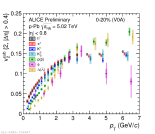
| v_{2}^{sub} \{2,|\Delta\eta| < 0.4\} of inclusive and identified hadrons in 0-20\% V0A multiplicity class
|
|
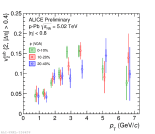
| v_{2}^{sub} \{2,|\Delta\eta| < 0.4\} of \phi in various V0A multiplicity classes
|
|
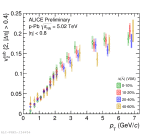
| v_{2}^{sub} \{2,|\Delta\eta| < 0.4\} of \Lambda(\bar{\Lambda}) in various V0A multiplicity classes
|
|
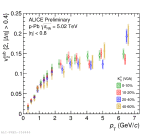
| v_{2}^{sub} \{2,|\Delta\eta| < 0.4\} of K_{S}^{0} in various V0A multiplicity classes
|
|
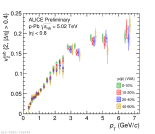
| v_{2}^{sub} \{2,|\Delta\eta| < 0.4\} of charged protons in various V0A multiplicity classes
|
|
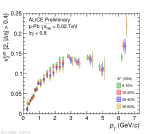
| v_{2}^{sub} \{2,|\Delta\eta| < 0.4\} of charged kaons in various V0A multiplicity classes
|
|
| v_{2}^{sub} \{2,|\Delta\eta| < 0.4\} of charged pions in various V0A multiplicity classes
|

|
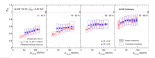
| Charged Jet RAA in Pb-Pb 5.02TeV (R=0.2, R=0.3)
|
|
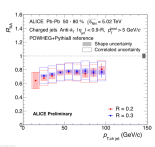
| Charged Jet RAA in Pb-Pb 5.02TeV for 50-80% centrality (R=0.2, R=0.3)
|
|
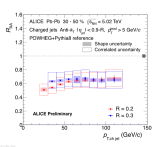
| Charged Jet RAA in Pb-Pb 5.02TeV for 30-50% centrality (R=0.2, R=0.3)
|
|
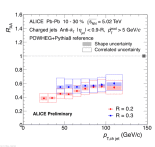
| Charged Jet RAA in Pb-Pb 5.02TeV for 10-30% centrality (R=0.2, R=0.3)
|
|
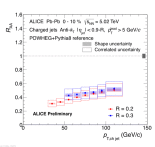
| Charged Jet RAA in Pb-Pb 5.02TeV for 0-10% centrality (R=0.2, R=0.3)
|
|
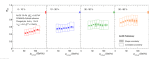
| Charged Jet RAA in Pb-Pb 5.02TeV (R=0.3)
|
|
| Charged Jet RAA in Pb-Pb 5.02TeV (R=0.2)
|
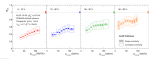
|
| Charged jet cross section ratio of R=0.2 to R=0.3 in Pb-Pb 5.02TeV
|
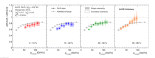
|
| Charged jet cross section ratio of R=0.2 to R=0.3 in Pb-Pb 5.02TeV for 50-80% centrality
|
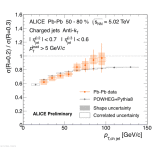
|
| Charged jet cross section ratio of R=0.2 to R=0.3 in Pb-Pb 5.02TeV for 30-50% centrality
|
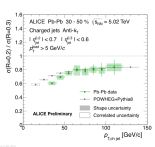
|
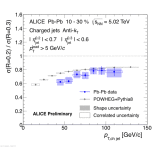
| Charged jet cross section ratio of R=0.2 to R=0.3 in Pb-Pb 5.02TeV for 10-30% centrality
|
|
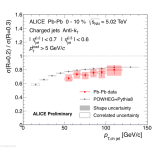
| Charged jet cross section ratio of R=0.2 to R=0.3 in Pb-Pb 5.02TeV for 0-10% centrality
|
|
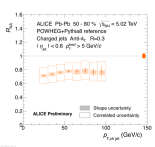
| Charged Jet RAA in Pb-Pb 5.02TeV for 50-80% centrality (R=0.3)
|
|
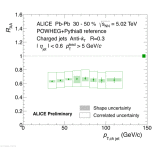
| Charged Jet RAA in Pb-Pb 5.02TeV for 30-50% centrality (R=0.3)
|
|
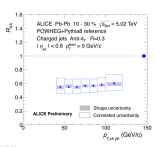
| Charged Jet RAA in Pb-Pb 5.02TeV for 10-30% centrality (R=0.3)
|
|
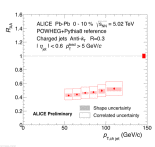
| Charged Jet RAA in Pb-Pb 5.02TeV for 0-10% centrality (R=0.3)
|
|
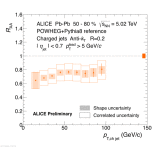
| Charged Jet RAA in Pb-Pb 5.02TeV for 50-80% centrality (R=0.2)
|
|
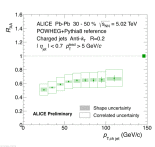
| Charged Jet RAA in Pb-Pb 5.02TeV for 30-50% centrality (R=0.2)
|
|
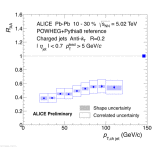
| Charged Jet RAA in Pb-Pb 5.02TeV for 10-30% centrality (R=0.2)
|
|
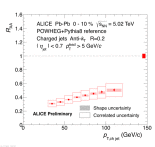
| Charged Jet RAA in Pb-Pb 5.02TeV for 0-10% centrality (R=0.2)
|
|
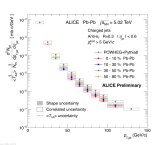
| TAA scaled charged Jet spectra in Pb-Pb 5.02TeV (R=0.3)
|
|
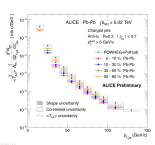
| TAA scaled charged Jet spectra in Pb-Pb 5.02TeV (R=0.2)
|
|
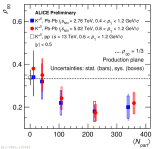
| rho_00 vs <Npart> for pT range 0.8 - 5.0 GeV/c w.r.t. Production plane for K*0 in Pb-Pb collisions at 2.76 and 5.02 TeV
|

|
| rho_00 vs <Npart> for pT range 0.8 - 1.2 GeV/c w.r.t. Production plane for K*0 in Pb-Pb collisions at 2.76 and 5.02 TeV
|
|