Self normalization yield of phi-meson at 0.5-1.0 GeV/c at forward-rapidity (2.5<y<4.0) as a function of the charged particle multiplicity at mid-rapidity (|\eta|<1.0) compared with Pythia8 predictions (Color rope + hadronic rescattering)
- Fig. Group : Low mass dimuons
- PWG : PWG-LF (Light Flavour Spectra)
- Energy: 13 TeV
- System p-p
|

|
| ML Full Jet Raa Compared to Area-Based Raa, R=0.4, 10%
|

|
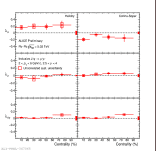
| lambda_Theta, lambda_Phi, lambda_ThetaPhi vs centrality in Pb-Pb collisions at sqrt(s_NN) = 5.02 TeV, in the Helicity and Collins-Soper reference frames
|
|
Self normalization yield of omega-meson at 6.0-8.0 GeV/c at forward-rapidity (2.5<y<4.0) as a function of the charged particle multiplicity at mid-rapidity (|\eta|<1.0) compared with Pythia8 predictions
- Fig. Group : Low mass dimuons
- PWG : PWG-LF (Light Flavour Spectra)
- Energy: 13 TeV
- System p-p
|

|
Self normalization yield of omega-meson at 2.5-3.0 GeV/c at forward-rapidity (2.5<y<4.0) as a function of the charged particle multiplicity at mid-rapidity (|\eta|<1.0) compared with Pythia8 predictions
- Fig. Group : Low mass dimuons
- PWG : PWG-LF (Light Flavour Spectra)
- Energy: 13 TeV
- System p-p
|

|
Self normalization yield of omega-meson at 0.5-1.0 GeV/c at forward-rapidity (2.5<y<4.0) as a function of the charged particle multiplicity at mid-rapidity (|\eta|<1.0) compared with Pythia8 predictions
- Fig. Group : Low mass dimuons
- PWG : PWG-LF (Light Flavour Spectra)
- Energy: 13 TeV
- System p-p
|

|
Self normalization yield of phi-meson at 6.0-8.0 GeV/c at forward-rapidity (2.5<y<4.0) as a function of the charged particle multiplicity densities at mid-rapidity (|\eta|<1.0)
- Fig. Group : Low mass dimuons
- PWG : PWG-LF (Light Flavour Spectra)
- Energy: 13 TeV
- System p-p
|

|
Self normalization yield of phi-meson at 2.5-3.0 GeV/c at forward-rapidity (2.5<y<4.0) as a function of the charged particle multiplicity densities at mid-rapidity (|\eta|<1.0)
- Fig. Group : Low mass dimuons
- PWG : PWG-LF (Light Flavour Spectra)
- Energy: 13 TeV
- System p-p
|

|
Self normalization yield of phi-meson at 0.5-1.0 GeV/c at forward-rapidity (2.5<y<4.0) as a function of the charged particle multiplicity at mid-rapidity (|\eta|<1.0) compared with Pythia8 predictions
- Fig. Group : Low mass dimuons
- PWG : PWG-LF (Light Flavour Spectra)
- Energy: 13 TeV
- System p-p
|

|
pT spectra of omega-meson in pp collisions in SPDTrk multiplicity classes and Ratios to INEL>0 with SPDTrk percentile
- Fig. Group : Low mass dimuons
- PWG : PWG-LF (Light Flavour Spectra)
- Energy: 13 TeV
- System p-p
|

|
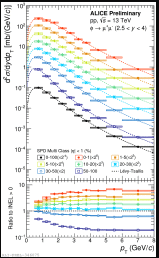
pT spectra of phi-meson in pp collisions in SPD Trk multiplicity classes and Ratios to INEL>0 with SPDTrk percentile
- Fig. Group : Low mass dimuons
- PWG : PWG-LF (Light Flavour Spectra)
- Energy: 13 TeV
- System p-p
|
|
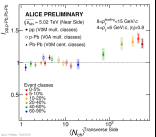
| Ipp, IpA and IAA as a function of average multiplicity in transverse region for near side in pp, p-Pb and Pb-Pb collisions at 5.02 TeV
|
|
| vn of inclusive and identified particles for unbiased, 0-10% and 90-100% qn classes for 5-10% and 30-40% centrality classes in Pb-Pb collisions
|

|
| Transverse pT spectra
|

|
| Scaled width of the V0 asymmetry distribution as a function of V0M/<V0M> in pp 13 TeV
|

|
| Mean V0M asymmetry as a function of V0M/<V0M> for different event bias in pp 13 TeV
|

|
| V0M asymmetry distributions in bins of V0M/<V0M> in pp 13 TeV for TT{6,7}
|

|
| V0M asymmetry distributions in bins of V0M/<V0M> in pp 13 TeV
|

|
| V0M/<V0M> distribution as measured by ALICE in high multiplicity pp 13 TeV in 2016, 2017 and 2018
|

|
| V0M/<V0M> distribution as measured by ALICE in minimum bias pp 13 TeV in 2016, 2017 and 2018
|

|
| V0M/<V0M> distribution as measured by ALICE in minimum bias pp 13 TeV and as simulated by PYTHIA8 Monash
|

|
| V0M/<V0M> distribution as measured by ALICE in minimum bias pp 13 TeV
|

|
| Per trigger normalized recoil jet yields associated to TT{20,30} and TT{6,7} and the corresponding Delta recoil spectrum as a function of jet pT in HM pp 13 TeV events
|

|
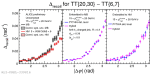
| Per trigger normalized recoil jet yields associated to TT{20,30} and TT{6,7} and the corresponding Delta recoil spectrum as a function of azimuth in HM pp 13 TeV events
|

|
| Delta recoil distributions for 15<pT,jet<20 GeV jet as measured by ALICE compated to PYTHIA events embedded to MB and HM pp 13 TeV
|
|
| Delta recoil distributions as measured by ALICE compated to PYTHIA events embedded to MB and HM pp 13 TeV
|

|
| Delta recoil distributions as measured by ALICE and simulated by PYTHIA8 particle level in MB and HM pp 13 TeV
|

|
| Per trigger normalized yield of 15<pT,jet<20 GeV recoil jets in MB and HM events for TT{20,30} in pp 13 TeV
|

|
| Delta_recoil distribution as a function of azimuth for charged akt R=0.4 jets with 40< pT,jet<60 GeV/c in pp 13 TeV
|

|
| Delta_recoil distribution as a function of azimuth for charged akt R=0.4 jets with 20< pT,jet<30 GeV/c in pp 13 TeV
|

|
| Delta_recoil distribution as a function of azimuth for charged akt R=0.4 jets with 15< pT,jet<20 GeV/c in pp 13 TeV
|

|
| Delta_recoil distribution as a function of azimuth for charged akt R=0.4 jets with 10< pT,jet<15 GeV/c in pp 13 TeV
|

|
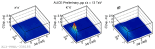
| Angular correlation functions for unlike-sign pairs of pions, kaons and protons
|
|
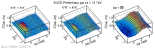
| Angular correlations of like-sign particles (pions, kaons, protons) in pp collisions at 13 TeV
|
|
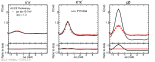
| Projections of angular correlation functions for unlike-sign pairs of pions, kaons and protons
|
|
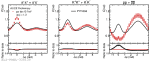
| Projections of angular correlation functions for like-sign pairs of pions, kaons and protons
|
|
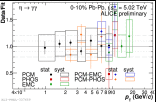
| Eta - Ratio of individual measurements to combined - 0-10% centrality - PbPb 5TeV
|
|
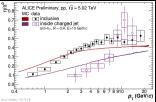
| Eta to pi0 ratio - in-jet and MB - pp 5TeV
|
|
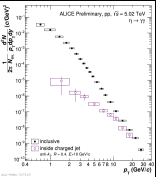
| Eta - in-jet and MB production - pp 5TeV
|
|
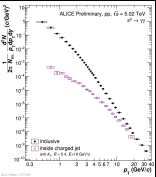
| Pi0 - in-jet and MB production - pp 5TeV
|
|
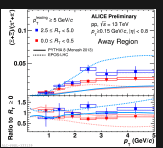
| $p_\textrm{T}$-differential model comparison of xi-to-pion ratio as a function of $R_\textrm{T}$ in the Away region for pp collisions at $\sqrt{s}$ = 13 TeV .
|
|
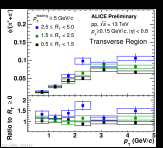
| $p_\textrm{T}$-differential model comparison of xi-to-pion ratio as a function of $R_\textrm{T}$ in the Transverse region for pp collisions at $\sqrt{s}$ = 13 TeV .
|

|
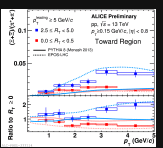
| $p_\textrm{T}$-differential model comparison of xi-to-pion ratio as a function of $R_\textrm{T}$ in the Toward region for pp collisions at $\sqrt{s}$ = 13 TeV .
|
|
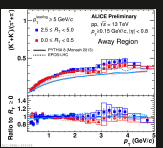
| $p_\textrm{T}$-differential model comparison of kaon-to-pion ratio as a function of $R_\textrm{T}$ in the Away region for pp collisions at $\sqrt{s}$ = 13 TeV .
|
|
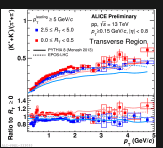
| $p_\textrm{T}$-differential model comparison of kaon-to-pion ratio as a function of $R_\textrm{T}$ in the Transverse region for pp collisions at $\sqrt{s}$ = 13 TeV .
|
|
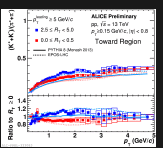
| $p_\textrm{T}$-differential model comparison of kaon-to-pion ratio as a function of $R_\textrm{T}$ in the Toward region for pp collisions at $\sqrt{s}$ = 13 TeV .
|
|
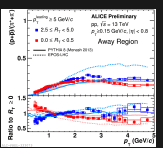
| $p_\textrm{T}$-differential model comparison of proton-to-pion ratio as a function of $R_\textrm{T}$ in the Away region for pp collisions at $\sqrt{s}$ = 13 TeV .
|
|
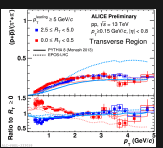
| $p_\textrm{T}$-differential model comparison of proton-to-pion ratio as a function of $R_\textrm{T}$ in the Transverse region for pp collisions at $\sqrt{s}$ = 13 TeV .
|
|
| $p_\textrm{T}$-differential model comparison of proton-to-pion ratio as a function of $R_\textrm{T}$ in the Toward region for pp collisions at $\sqrt{s}$ = 13 TeV .
|

|
| $p_\textrm{T}$-differential model comparison of phi-to-pion ratio as a function of $R_\textrm{T}$ in the Away region for pp collisions at $\sqrt{s}$ = 13 TeV .
|

|
| $p_\textrm{T}$-differential model comparison of phi-to-pion ratio as a function of $R_\textrm{T}$ in the Transverse region for pp collisions at $\sqrt{s}$ = 13 TeV .
|

|
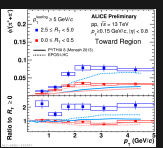
| $p_\textrm{T}$-differential model comparison of phi-to-pion ratio as a function of $R_\textrm{T}$ in the Toward region for pp collisions at $\sqrt{s}$ = 13 TeV .
|
|
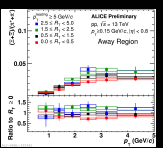
| $p_\textrm{T}$-differential xi-to-pion ratio as a function of $R_\textrm{T}$ in the Away region for pp collisions at $\sqrt{s}$ = 13 TeV .
|
|
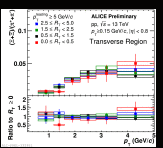
| $p_\textrm{T}$-differential xi-to-pion ratio as a function of $R_\textrm{T}$ in the Transverse region for pp collisions at $\sqrt{s}$ = 13 TeV .
|
|
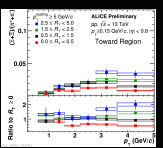
| $p_\textrm{T}$-differential xi-to-pion ratio as a function of $R_\textrm{T}$ in the Toward region for pp collisions at $\sqrt{s}$ = 13 TeV .
|
|
| $p_\textrm{T}$-differential kaon-to-pion ratio as a function of $R_\textrm{T}$ in the Away region for pp collisions at $\sqrt{s}$ = 13 TeV .
|

|
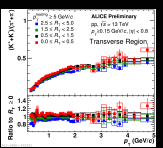
| $p_\textrm{T}$-differential kaon-to-pion ratio as a function of $R_\textrm{T}$ in the Transverse region for pp collisions at $\sqrt{s}$ = 13 TeV .
|
|
| $p_\textrm{T}$-differential kaon-to-pion ratio as a function of $R_\textrm{T}$ in the Toward region for pp collisions at $\sqrt{s}$ = 13 TeV .
|

|
| $p_\textrm{T}$-differential proton-to-pion ratio as a function of $R_\textrm{T}$ in the Transverse region for pp collisions at $\sqrt{s}$ = 13 TeV .
|

|
| $p_\textrm{T}$-differential proton-to-pion ratio as a function of $R_\textrm{T}$ in the Toward region for pp collisions at $\sqrt{s}$ = 13 TeV .
|

|
| $p_\textrm{T}$-differential phi-to-pion ratio as a function of $R_\textrm{T}$ in the Away region for pp collisions at $\sqrt{s}$ = 13 TeV .
|

|
| $p_\textrm{T}$-differential phi-to-pion ratio as a function of $R_\textrm{T}$ in the Transverse region for pp collisions at $\sqrt{s}$ = 13 TeV .
|
|
| Low-mass dielectron pT,ee (PYTHIA+EPS09, 1.04 < mee < 2.4, pt > 0.2)
|

|
| $p_\textrm{T}$-differential phi-to-pion ratio as a function of $R_\textrm{T}$ in the Toward region for pp collisions at $\sqrt{s}$ = 13 TeV .
|

|
| Cross section of heavy-flvaour jets with electrons in pp at 5.02 TeV with POWHEG (R=0.6)
|

|
Low pT,ee spectrum in 0-40% centrality with calculations for thermal and photo-production dielectrons.
- Fig. Group : low pTee spectra
- PWG : PWG-DQ (Dileptons and Quarkonia)
- Energy: 5.02 TeV
- System Pb-Pb
|

|
Low pT,ee spectrum in 70-90% centrality with calculations for thermal and photo-production dielectrons.
- Fig. Group : low pTee spectra
- PWG : PWG-DQ (Dileptons and Quarkonia)
- Energy: 5.02 TeV
- System Pb-Pb
|

|
| Toward pT spectra
|

|
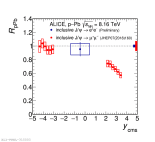
RpPb jpsi at mid-rapidity in comparison with preliminary result at 5 TeV (min bias data)
- Fig. Group : p-Pb 8 TeV min bias
- PWG : PWG-DQ (Dileptons and Quarkonia)
- Energy: 8 TeV
- System p-Pb
|

|
| Anti-deuteron inelastic interaction cross-section with ALICE material
|

|
| Anti-proton inelastic interaction cross-section with ALICE material
|

|
Low pT,ee spectrum in 0-40% centrality with Rapp prediction
- Fig. Group : low pTee spectra
- PWG : PWG-DQ (Dileptons and Quarkonia)
- Energy: 5.02 TeV
- System Pb-Pb
|

|
Low pT,ee spectrum in 70-90% centrality with Rapp prediction
- Fig. Group : low pTee spectra
- PWG : PWG-DQ (Dileptons and Quarkonia)
- Energy: 5.02 TeV
- System Pb-Pb
|

|
Comparison of J/ψ yield at mid and forward rapidity, as a function of the charged particle multiplicity densities at mid-rapidity
- Fig. Group : J/psi->mu+mu-
- PWG : PWG-DQ (Dileptons and Quarkonia)
- Energy: 13 TeV
- System p-p
|

|
Low pT,ee spectrum in 0-40% centrality
- Fig. Group : low pTee spectra
- PWG : PWG-DQ (Dileptons and Quarkonia)
- Energy: 5.02 TeV
- System Pb-Pb
|

|
Low pT,ee spectrum in 70-90% centrality
- Fig. Group : low pTee spectra
- PWG : PWG-DQ (Dileptons and Quarkonia)
- Energy: 5.02 TeV
- System Pb-Pb
|

|
pt differential RpPb jpsi at mid-rapidity (min bias data) at 8TeV in comparison with theory calculations
- Fig. Group : p-Pb 8 TeV min bias
- PWG : PWG-DQ (Dileptons and Quarkonia)
- Energy: 8 TeV
- System p-Pb
|

|
pt differential RpPb jpsi at mid-rapidity (min bias data) at 8TeV
- Fig. Group : p-Pb 8 TeV min bias
- PWG : PWG-DQ (Dileptons and Quarkonia)
- Energy: 8 TeV
- System p-Pb
|

|
RpPb jpsi at mid-rapidity in comparison with muon result at 8 TeV (min bias data) and theory calculations
- Fig. Group : p-Pb 8 TeV min bias
- PWG : PWG-DQ (Dileptons and Quarkonia)
- Energy: 8 TeV
- System p-Pb
|

|
RpPb jpsi at mid-rapidity in comparison with muon result at 8 TeV (min bias data)
- Fig. Group : p-Pb 8 TeV min bias
- PWG : PWG-DQ (Dileptons and Quarkonia)
- Energy: 8 TeV
- System p-Pb
|
|
| RpPb for D0-tagged jets at 5.02 TeV, linear scale on x-axis (for comparison with RAA, part 1)
|

|
| Xi to Lambda Ratio in jet within pp with jet R=0.4 Matching R=0.4
|

|
| Scope: PAG Lambda to Kshort Ratio in jet within pp with jet R=0.4 Matching R=0.4
|

|
Dielectron mass spectra in pp (7 and 13 TeV) and PbPb (2.76 and 5.02 TeV) collisions
- Fig. Group : Low Mass -> e+e-
- PWG : PWG-DQ (Dileptons and Quarkonia)
- Energy: 2.76 TeV
, - Energy: 5.02 TeV
, - Energy: 7 TeV
, - Energy: 13 TeV
- System p-p ,
- System Pb-Pb
|

|
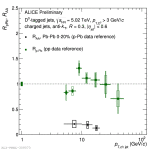
| RpPb and RAA for D0-tagged jets at 5.02 TeV, linear scale on x-axis
|

|
Comparison of Υ(1S) and Y(2S) yields at forward rapidity, as a function of the charged particle multiplicity at mid-rapidity
- Fig. Group : Upsilon -> mu+mu-
- PWG : PWG-DQ (Dileptons and Quarkonia)
- Energy: 13 TeV
- System p-p
|

|
Bottomonium production rate as a function of charged particle multiplicity
- Fig. Group : Upsilon -> mu+mu-
- PWG : PWG-DQ (Dileptons and Quarkonia)
- Energy: 13 TeV
- System p-p
|

|
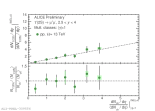
Υ(2S) yield at forward-rapidity as a function of the charged particle multiplicity at mid-rapidity with the deviation from linearity
- Fig. Group : Upsilon -> mu+mu-
- PWG : PWG-DQ (Dileptons and Quarkonia)
- Energy: 13 TeV
- System p-p
|
|
Y(2S) yield at forward-rapidity as a function of the charged particle multiplicity densities at mid-rapidity
- Fig. Group : Upsilon -> mu+mu-
- PWG : PWG-DQ (Dileptons and Quarkonia)
- Energy: 13 TeV
- System p-p
|

|
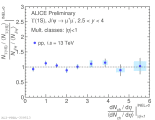
Comparison of Υ(1S) and J/ψ yields at forward rapidity, as a function of the charged particle multiplicity at mid-rapidity
- Fig. Group : Upsilon -> mu+mu-
- PWG : PWG-DQ (Dileptons and Quarkonia)
- Energy: 13 TeV
- System p-p
|
|
Υ(1S) yield at forward-rapidity as a function of the charged particle multiplicity at mid-rapidity with the deviation from linearity
- Fig. Group : Upsilon -> mu+mu-
- PWG : PWG-DQ (Dileptons and Quarkonia)
- Energy: 13 TeV
- System p-p
|

|
Υ(1S) yield at forward-rapidity as a function of the charged particle multiplicity densities at mid-rapidity
- Fig. Group : Upsilon -> mu+mu-
- PWG : PWG-DQ (Dileptons and Quarkonia)
- Energy: 13 TeV
- System p-p
|

|
J/ψ yield at forward-rapidity as a function of the charged particle multiplicity densities at mid-rapidity with the deviation from linearity
- Fig. Group : J/psi->mu+mu-
- PWG : PWG-DQ (Dileptons and Quarkonia)
- Energy: 13 TeV
- System p-p
|

|
| Reconstruction efficiency of D0-tagged charged jets, pp at 5.02 TeV (Run2)
|

|
| Raw D0-tagged charged jets pT distributions, D0 pT intervals, pp at 5.02 TeV (Run2)
|

|
| D0-tagged charged jets: invariant mass distributions in 3 D0 pT intervals, pp at 5.02 TeV (Run 2)
|

|
| RpPb for D0-tagged jets at 5.02 TeV
|

|
| Cross section of D0-tagged charged jets (anti-kT, R=0.3) with pT,D > 3 GeV/c, in pp and p-Pb at 5.02 TeV
|

|
| RpPb and RAA for D0-tagged jets at 5.02 TeV
|
|
| Cross section of D0-tagged jets in pp at 5.02 TeV
|

|