| Ds-K ULS and LS azimuthal correlation distribution comparison (5 < $p_{T}$ < 8 GeV/c) comparison with models
|

|
| Ds-$pi$ ULS and LS azimuthal correlation distribution comparison (5 < $p_{T}$ < 8 GeV/c) comparison with models
|

|
| Ds-$\pi$ ULS-LS azimuthal correlation distribution (1 < $p_{T}$ < 3 GeV/c) comparison with models
|

|
| Ds-K ULS-LS near-side yield comparison with models
|

|
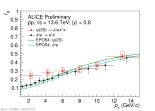
| Non-prompt $\psi$(2S) and J/$\psi$ fraction compare with EPOS4
|
|
| Ds-$\pi$ ULS-LS azimuthal correlation distribution (1 < $p_{T}$ < 3 GeV/c)
|

|
| Ds-$\pi$ ULS-LS azimuthal correlation distribution (3 < $p_{T}$ < 5 GeV/c)
|

|
| Ds-$\pi$ ULS-LS azimuthal correlation distribution (5 < $p_{T}$ < 8 GeV/c)
|

|
| Ds-$\pi$ ULS-LS azimuthal correlation distribution (8 < $p_{T}$ < 16 GeV/c)
|

|
| Ds-K ULS-LS azimuthal correlation distribution (8 < $p_{T}$ < 16 GeV/c)
|

|
| Ds-K ULS-LS azimuthal correlation distribution (5 < $p_{T}$ < 8 GeV/c)
|

|
| Ds-K ULS-LS azimuthal correlation distribution (3 < $p_{T}$ < 5 GeV/c)
|

|
| Ds-K ULS-LS azimuthal correlation distribution (1 < $p_{T}$ < 3 GeV/c)
|

|
| Ds-$pi$ ULS and LS azimuthal correlation distribution comparison (1 < $p_{T}$ < 3 GeV/c)
|

|
| Ds-$pi$ ULS and LS azimuthal correlation distribution comparison (3 < $p_{T}$ < 5 GeV/c)
|

|
| Ds-$pi$ ULS and LS azimuthal correlation distribution comparison (5 < $p_{T}$ < 8 GeV/c)
|

|
| Ds-$pi$ ULS and LS azimuthal correlation distribution comparison (8 < $p_{T}$ < 16 GeV/c)
|

|
| Ds-K ULS and LS azimuthal correlation distribution comparison (8 < $p_{T}$ < 16 GeV/c)
|

|
| Ds-K ULS and LS azimuthal correlation distribution comparison (5 < $p_{T}$ < 8 GeV/c)
|

|
| Ds-K ULS and LS azimuthal correlation distribution comparison (3 < $p_{T}$ < 5 GeV/c)
|

|
| Ds-K ULS and LS azimuthal correlation distribution comparison (1 < $p_{T}$ < 3 GeV/c)
|

|
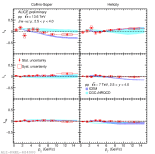
| Comparison of polarization parameters with ICEM and CGC+NRQCD model predictions
|
|
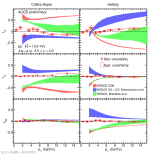
| Comparison of polarization parameters as a function of pT in pp 13.6 TeV with NRQCD model predictions
|
|
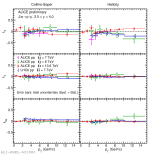
| Comparison of polarization parameters as a function of pT in pp 13.6 TeV with 7 and 8 TeV
|
|
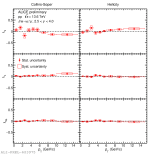
| Polarization parameters as a function of pT in pp 13.6 TeV
|
|
| Ds-meson invariant mass distribution (3 < $p_{T}$ < 5GeV/c)
|

|
| Ds-h azimuthal correlation distribution (16 < $p_{T}$ < 36 GeV/c)
|

|
| Ds-h azimuthal correlation distribution (8 < $p_{T}$ < 16 GeV/c)
|

|
| Ds-h azimuthal correlation distribution (5 < $p_{T}$ < 8 GeV/c)
|

|
| Ds-h azimuthal correlation distribution (3 < $p_{T}$ < 5 GeV/c)
|

|
| Ds-h azimuthal correlation distribution (1 < $p_{T}$ < 3 GeV/c)
|

|
| Ds-h ($\Delta\phi,\Delta\eta$) angular correlation distribution (8 < $p_{T}$ < 16 GeV/c)
|

|
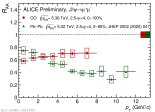
| J/$\psi$ ROO vs pT (Model Comparison) in OO collisions at $\sqrt{s_{\mathrm{NN}}}$ = 5.36 TeV in the dimuon channel at forward rapidity [SQM26]
|
|
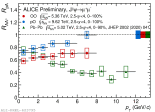
| J/$\psi$ ROO vs pT (Model Comparison) in OO collisions at $\sqrt{s_{\mathrm{NN}}}$ = 5.36 TeV in the dimuon channel at forward rapidity [SQM26]
|
|
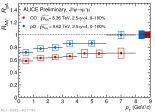
| J/$\psi$ ROO vs pT (Model Comparison) in OO collisions at $\sqrt{s_{\mathrm{NN}}}$ = 5.36 TeV in the dimuon channel at forward rapidity [SQM26]
|
|
| J/$\psi$ ROO vs pT (Model Comparison) in OO collisions at $\sqrt{s_{\mathrm{NN}}}$ = 5.36 TeV in the dimuon channel at forward rapidity [SQM26]
|
|
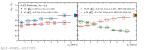
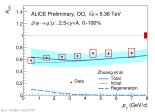
| J/$\psi$ ROO vs pT (Model Comparison) in OO collisions at $\sqrt{s_{\mathrm{NN}}}$ = 5.36 TeV in the dimuon channel at forward rapidity [SQM26]
|
|
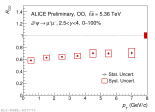
| J/$\psi$ ROO vs pT in OO collisions at $\sqrt{s_{\mathrm{NN}}}$ = 5.36 TeV in the dimuon channel at forward rapidity [SQM26]
|
|
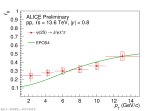
| Non-prompt $\psi$(2S) fraction compare with EPOS4
|
|
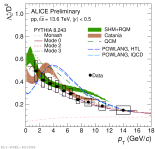
| $\mathrm{\Lambda_{c}^{+}}/\mathrm{D}^0$ ratio in pp collisions at $\sqrt{s} = 13.6\ \mathrm{TeV}$
|
|
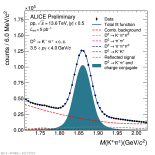
| Fit to the invariant-mass distribution of prompt $\mathrm{D}^{0}$ in the $3.5 < p_{\mathrm{T}} < 4 \mathrm{GeV}/c$ interval, in pp collisions at $\sqrt{s} = 13.6 \ \mathrm{TeV}$
|
|
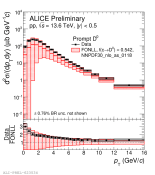
| Prompt $\mathrm{D}^0$ cross section in pp collisions at $\sqrt{s} = 13.6\ \mathrm{TeV}$ compared with FONLL
|
|
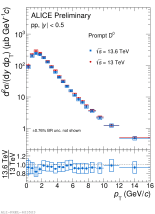
| Prompt $\mathrm{D}^0$ cross section in pp collisions at $\sqrt{s} = 13.6\ \mathrm{TeV}$ compared with Run 2 measurement
|
|
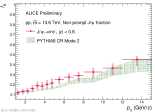
| fB in mid rapidities compared with PYTHIA comparisons
|
|
| The model comparison of differential cross section of inclusive J/psi at midrapidity in pp collisions at 5.36 TeV
|

|
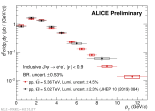
| Differential cross section of inclusive J/psi at midrapidity in pp collisions at 5.36 TeV
|
|
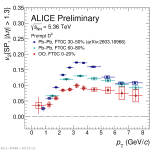
| Prompt $D^0$ elliptic flow comparison from semicentral Pb--Pb to central OO collisions
|
|
| J/ψ v2 as a function of centrality at high pT in OO collisions, compared with results in Pb-Pb collisions
|

|
| J/ψ v2 as a function of centrality at low pT in OO collisions, compared with results in Pb-Pb collisions
|

|
| J/ψ v2 as a function of pT in semi-central OO collisions, compared with results in p-Pb and Pb-Pb collisions
|

|
| J/ψ v2 as a function of pT in central OO collisions, compared with results in p-Pb and Pb-Pb collisions
|

|
| J/ψ v2 as a function of pT in semi-central OO collisions compared with model calculations
|

|
| J/ψ v2 as a function of pT in central OO collisions compared with model calculations
|

|
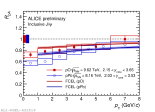
| Nuclear modification factor of J/psi in pO collisions as a function of pT, compared with p-Pb data and with FCEL model
|
|
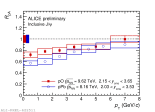
| Nuclear modification factor of J/psi in pO collisions as a function of pT, compared with p-Pb data
|
|
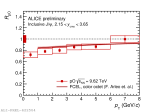
| Nuclear modification factor of J/psi in pO collisions as a function of pT, compared with FCEL model
|
|
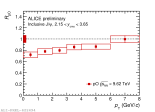
| Nuclear modification factor of J/psi in pO collisions as a function of pT
|
|
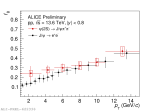
| Non-prompt $\psi$(2S) fraction compare with non-prompt J/$\psi$ fraction
|
|
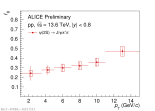
| Non-prompt $\psi$(2S) fraction in pp at 13.6 TeV
|
|
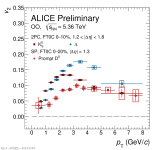
| Prompt $D^0$ elliptic flow comparison with light flavour hadrons
|
|
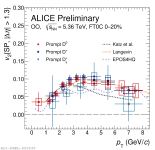
| Charm meson elliptic flow in central OO collisions
|
|
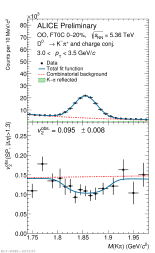
| $D^0$ meson simultaneous fit
|
|
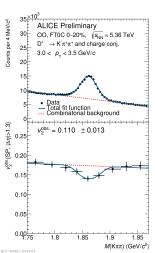
| $D^+$ meson simultaneous fit
|
|
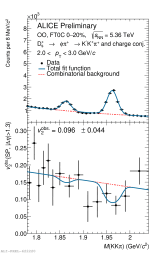
| $D_s^+$ meson simultaneous fit
|
|
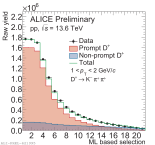
| Fit to the raw-yield distribution of $D^{+}$ mesons for different BDT non-prompt scores performed to extract the $D^{+}$ $f_{\mathrm{non-prompt}}$ fraction in the 1<pT<2 GeV/c in pp collisions at 13.6 TeV
|
|
| Comparison of p$D^{-}$ momentum correlation function with model predictions in proton–proton collisions at 13.6 TeV
|

|
| Comparison of p$D^{+}$ momentum correlation function with model predictions in proton–proton collisions at 13.6 TeV
|

|
| Raw correlation function of p$D^{\pm}$ and simulation of non-femtosocpy background of p$D^{\pm}$ in proton–proton collisions at 13.6 TeV
|

|
| Fit to the invariant-mass distribution of $D^{+}$ mesons in mixed events in the 0.06 < $k^{*}$ <0.10 GeV/c in proton–proton collisions at 13.6 TeV
|

|
| Fit to the invariant-mass distribution of $D^{+}$ mesons in same events in the 0.06 < $k^{*}$ <0.10 GeV/c in proton–proton collisions at 13.6 TeV
|

|
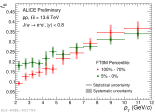
| Highest and lowest multiplicity nonprompt \jpsi~fB at mid-rapidity in pp collisions at $\sqrt{s} = $ 13.6 TeV [SQM2026]
|
|
| Multiplicity dependence fB of \jpsi~at mid-rapidity in pp collisions at $\sqrt{s} = $ 13.6 TeV [SQM2026]
|

|
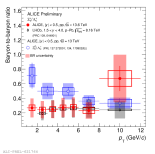
| $\Xi_c^+/\Lambda_c^+$ ratio compared with $\Xi_c^0/\Lambda_c^+$ by ALICE and $\Xi_c^+/\Lambda_c^+$ by LHCb
|
|
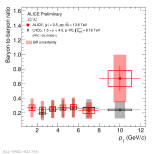
| $\Xi_c^+/\Lambda_c^+$ ratio compared with LHCb results
|
|
| BDT score for Omegac to Omega pi analysis in 4 < pT< 6 GeV/c in pp collisions at 13.6 TeV
|

|
| ROC curve for Omegac to Omega pi analysis in 4 < pT< 6 GeV/c in pp collisions at 13.6 TeV
|

|
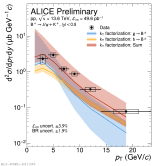
| B meson production cross section, comparison to kT factorization
|
|
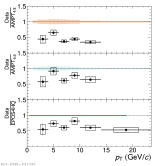
| B meson production cross section, comparison phenomenological models, ratio
|
|
| B meson production cross section, comparison phenomenological models
|
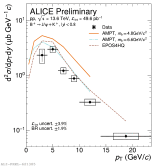
|
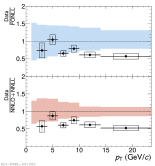
| B meson production cross section, comparison FONLL, NNLO+NNL, ratio
|
|
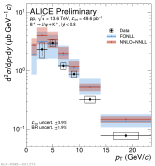
| B meson production cross section, comparison FONLL, NNLO+NNL
|
|
| OmegaC self normalized yields in pp collisions at 13.6 TeV
|

|
| OmegaC raw yield in 4_pT_6 and 10-50% FT0M
|

|
| OmegaC raw yield in 4_pT_6 and 0-10% FT0M
|

|
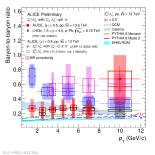
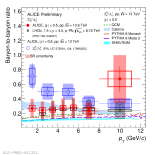
| $\Xi_c^+/\Lambda_c^+$ ratio compared with Run 2 results including $\Xi_c^+\rightarrow \Xi^- \pi^+ \pi^+$ and model predictions
|
|
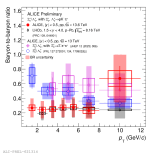
| $\Xi_c^+/\Lambda_c^+$ ratio compared with Run 2 results and model predictions
|
|
| $\Xi_c^+/\Lambda_c^+$ ratio compared with Run 2 results
|
|
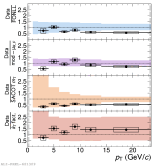
| B meson production cross section, comparison to pQCD-based models, ratios
|
|
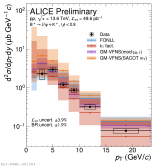
| B meson production cross section, comparison to pQCD-based models
|
|
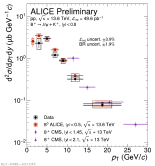
| B meson production cross section, comparison to data
|
|
| Ratio of $\pt$-integrated $\mathrm{D_s^+/D^+}$ production yield ratio measured in pp collisions at $\sqrt{s}=13.6$ TeV and $\mathrm{Pb-Pb}$ collisions at $\sqrt{s_\mathrm{NN}}=5.36$ TeV to low-multiplicity pp collisions, compared to $\mathrm{K}^+/\pi^+$
|

|
| $\pt$-integrated $\mathrm{D_s^+/D^+}$ production yield ratio measured in pp collisions at $\sqrt{s}=13.6$ TeV and $\mathrm{Pb-Pb}$ collisions at $\sqrt{s_\mathrm{NN}}=5.36$ TeV, compared to theoretical predictions
|

|
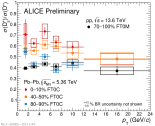
| $\mathrm{D_s^+/D^+}$ production yield ratio measured in pp collisions at $\sqrt{s}=13.6$ TeV and $\mathrm{Pb-Pb}$ collisions at $\sqrt{s_\mathrm{NN}}=5.36$ TeV as a function of $\pt$
|
|
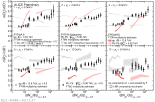
| $\mathrm{D_s^+/D^+}$ production yield ratio measured in pp collisions at $\sqrt{s}=13.6$ TeV and $\mathrm{Pb-Pb}$ collisions at $\sqrt{s_\mathrm{NN}}=5.36$ TeV compared to PYTHIA 8 and EPOS4HQ predictions (EPOS4HQ highlight)
|
|
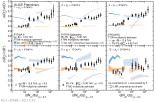
| $\mathrm{D_s^+/D^+}$ production yield ratio measured in pp collisions at $\sqrt{s}=13.6$ TeV and $\mathrm{Pb-Pb}$ collisions at $\sqrt{s_\mathrm{NN}}=5.36$ TeV compared to PYTHIA 8 and EPOS4HQ predictions (PYTHIA highlight)
|
|
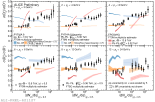
| $\mathrm{D_s^+/D^+}$ production yield ratio measured in pp collisions at $\sqrt{s}=13.6$ TeV and $\mathrm{Pb-Pb}$ collisions at $\sqrt{s_\mathrm{NN}}=5.36$ TeV compared to PYTHIA 8 and EPOS4HQ predictions
|
|
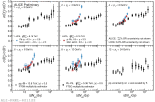
| $\mathrm{D_s^+/D^+}$ production yield ratio measured in pp collisions at $\sqrt{s}=13.6$ TeV and $\mathrm{Pb-Pb}$ collisions compared at $\sqrt{s_\mathrm{NN}}=5.36$ TeV compared to LHCb measurement in p$-$Pb collisions
|
|
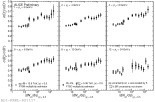
| $\mathrm{D_s^+/D^+}$ production yield ratio measured in pp collisions at $\sqrt{s}=13.6$ TeV and $\mathrm{Pb-Pb}$ collisions at $\sqrt{s_\mathrm{NN}}=5.36$ TeV
|
|
| Fit to the raw-yield distribution of $\mathrm{D^+}$ mesons for different BDT non-prompt scores performed to extract the $\mathrm{D^+}$ $f_\mathrm{prompt}$ fraction in the $2< \pt <4$ GeV/$c$ and $50-60\%$ FT0C interval
|

|
| Fit to the raw-yield distribution of $\mathrm{D_s^+}$ mesons for different BDT non-prompt scores performed to extract the $\mathrm{D_s^+}$ $f_\mathrm{prompt}$ fraction in the $2< \pt <4$ GeV/$c$ and $50-60\%$ FT0C interval
|

|