Figures from paper submitted to Physical Review Letters
Abstract:
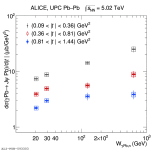
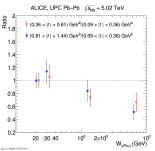
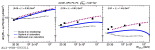
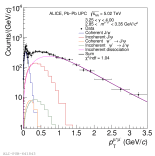
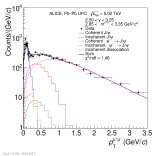
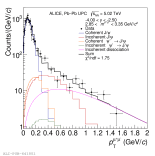
According to quantum chromodynamics, at sufficiently high energy, the structure of hadrons reveals a dynamic equilibrium between gluon splitting and gluon recombination$-$a phenomenon known as saturation. The process of diffractive photonuclear production of a J/$ψ$ vector meson provides a direct insight into the gluon composition of hadrons. The J/$ψ$ production as a function of momentum transferred in the interaction, quantified by the Mandelstam-$t$ variable, serves as an excellent probe for studying the structure of hadrons within the impact-parameter plane, because different ranges in $t$ are sensitive to the dynamics of the gluon field at varying spatial size scales. The ALICE collaboration has measured the energy dependence of incoherent photonuclear production of J/$ψ$ mesons off lead ions, at $\sqrt{s_{\rm NN}} = 5.02$ TeV, for three Mandelstam-$t$ intervals. The energy dependence of the photonuclear cross section at the highest $|t|$ range measured, $(0.81<~ |t| <~1.44$) GeV$^2$, is sensitive to subnucleonic structures of the Pb target. The increase of the cross section with energy at large $|t|$ shows evidence of suppression with respect to the increase seen at low $|t|$. The observed pattern of the energy evolution in data is similar to that of gluon saturation models.
Phys. Rev. Lett. 137 (2026) 052301
e-Print: arXiv:2503.18708 | PDF | inSPIRE