Figures from paper submitted to Journal of High Energy Physics
Abstract:
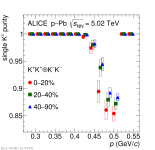
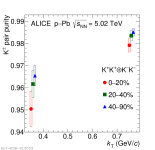
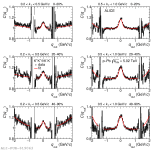
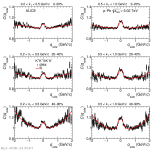
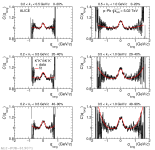
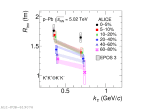
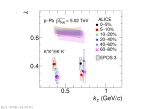
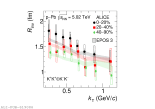
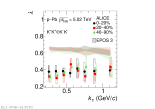
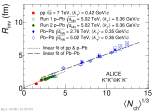
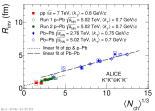
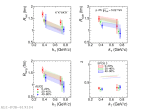
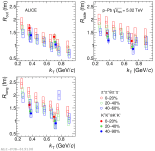
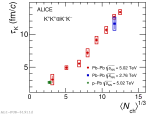
The measurement of three-dimensional femtoscopic correlations between identical charged kaons (K$^\pm$K$^\pm$) produced in p$-$Pb collisions at center-of-mass energy per nucleon pair $\sqrt{s{_{\rm NN}}} = 5.02$ TeV with ALICE at the LHC is presented for the first time. This measurement, supplementary to those in pp and Pb$-$Pb collisions, allows understanding the particle-production mechanisms at different charged-particle multiplicities and provides information on the dynamics of the source of particles created in p$-$Pb collisions, for which a general consensus does not yet exist. It is shown that the measured source sizes increase with charged-particle multiplicity and decrease with increasing pair transverse momentum. These trends for K$^\pm$K$^\pm$ are similar to the ones observed earlier in identical charged-pion and K$_{\rm s}^{0}$K$_{\rm s}^{0}$ correlations in Pb$-$Pb collisions at various energies and in $π^\pm π^\pm$ correlations in p$-$Pb collisions at $\sqrt{s{_{\rm NN}}} = 5.02$ TeV. At comparable multiplicity, the source sizes measured in p$-$Pb collisions agree within uncertainties with those observed in pp collisions, and there is an indication that they are smaller than those observed in Pb$-$Pb collisions. The obtained results are also compared with predictions from the hadronic interaction model EPOS~3, which tends to underestimate the source size for the most central collisions and agrees with the data for semicentral and peripheral events. Furthermore, the time of maximal emission for kaons is extracted. It turns out to be comparable with the value obtained in highly peripheral Pb$-$Pb collisions at the same energy, indicating that the kaon emission evolution is similar to that in p$-$Pb collisions.
e-Print: arXiv:2601.15081 | PDF | inSPIRE