Figures from paper submitted to Others
Abstract:
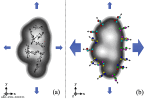
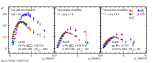
Quantum Chromodynamics predicts a phase transition from hadronic matter to quark$-$gluon plasma (QGP) at high temperatures and energy densities, where quarks and gluons (partons) are no longer confined within hadrons. The QGP forms in ultrarelativistic heavy-ion collisions. Anisotropic flow coefficients, quantifying the azimuthal expansion of produced matter, probe QGP properties. Flow measurements in high-energy heavy-ion collisions show a distinctive grouping of anisotropic flow for baryons and mesons at intermediate transverse momentum $-$ a feature associated with flow imparted at the quark level, confirming QGP existence. The observation of QGP-like features in proton$-$proton and proton$-$ion collisions has sparked debate about QGP formation in smaller systems. For the first time, we demonstrate the distinctive grouping of anisotropic flow for baryons and mesons in high-multiplicity proton$-$lead and proton$-$proton collisions at the Large Hadron Collider (LHC). These results are described by a model including hydrodynamic flow followed by hadron formation via quark coalescence, consistent with the formation of partonic flowing systems in these collisions.
Nature Commun. 17 (2026) 1, 2585
e-Print: arXiv:2411.09323 | PDF | inSPIRE