| Direct photon spectra in PbPb 5.02TeV from PCM and Dielectrons with comparison to model calculations
|

|
| Direct photon spectra in PbPb 5.02TeV from PCM
|

|
| Omega Ratio Of Individual Measurements To Combined Fit in pp 13TeV
|

|
| Ratio of the strongly intensive quantity Σ to MC HIJING in Xe-Xe collisions at √sNN = 5.44 TeV as a function of a distance between forward and backward intervals for 10% centrality bin width
|

|
| Ratio of the strongly intensive quantity Σ to MC HIJING in Pb-Pb collisions at √sNN = 5.02 TeV as a function of a distance between forward and backward intervals for 10% centrality bin width
|

|
| Ratio of the strongly intensive quantity Σ to MC HIJING in Pb-Pb collisions at √sNN = 2.76 TeV as a function of a distance between forward and backward intervals for 10% centrality bin width
|

|
| The strongly intensive quantity Σ in Xe-Xe collisions at √sNN = 5.44 TeV as a function of a distance between forward and backward intervals for 10% centrality bin width
|

|
| The strongly intensive quantity Σ in Pb-Pb collisions at √sNN = 5.02 TeV as a function of a distance between forward and backward intervals for 10% centrality bin width
|

|
| The strongly intensive quantity Σ in Pb-Pb collisions at √sNN = 2.76 TeV as a function of a distance between forward and backward intervals for 10% centrality bin width
|

|
| Lambda(1520)/Lambda yield ratio as a function of charged particle multiplicity
|

|
| The strongly intensive quantity Σ in Pb-Pb and Xe-Xe collsions as a function of centrality
|

|
| Example of template fit using four templates in 6 < pT < 8 GeV/c
|

|
| Example of template fit using four templates in 1.3 < pT < 1.5 GeV/c
|

|
| Ratio of beauty decay electrons in pp collisions at 13 TeV with one in pp collisions at 5.02 TeV
|

|
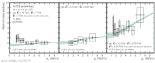
| Ratio of beauty decay electrons in pp collisions at 13 TeV with ones in pp at 2.76, 5.02, and 7 TeV
|
|
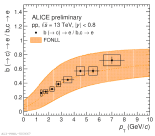
| Ratio of beauty decay electrons to heavy-flavour decay electrons in pp collisions at 13 TeV
|
|
| Cross section of beauty decay electrons in pp collisions at 13 TeV
|

|
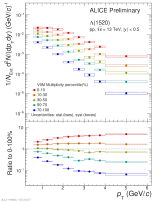
| Corrected transverse momentum spectra of Lambda(1520) at 13 TeV
|
|
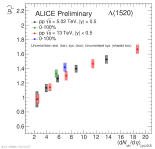
| Lambda(1520) mean transverse momentum at \sqrt{s} = 5.02 and 13 TeV
|
|
| Lambda(1520) pT integrated yield (dN/dy) at \srqt{s} = 5.02 TeV and 13 TeV
|

|
| Corrected transverse momentum spectra of Lambda(1520) at 5.02TeV
|

|
| $R$ and $\mu$ vs $k_{\mathrm T}$
|

|
| $R$ and $\mu$ vs $<{\mathrm d}{N_{\mathrm {ch}}}/{\mathrm d}\eta>^{1/3}$
|

|
| Correlation functions for pion-kaon pairs with their fits for 20-30% centrality
|

|
| Correlation functions for pion-kaon pairs with non-femtoscopic background for Pb$-$Pb collisions at $\sqrt{s_{\mathrm {NN}}}=5.02$ for 20$-$30% centrality
|

|
| Effect of hadronic resonance decays: Δη dependence
|

|
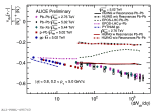
| Scaled nudyn[+,-] Vs dNch/deta
|
|
| Comparison with lower energies
|

|
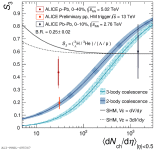
S_{3} in p-Pb and pp collisions
- Fig. Group : Hypertriton in pPb and pp
- PWG : PWG-LF (Light Flavour Spectra)
- Energy: 5.02 TeV
, - Energy: 13 TeV
- System p-p ,
- System p-Pb
|
|
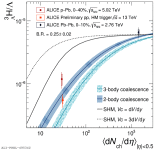
Hypertriton/$\Lambda$ in p-Pb and p-p
- Fig. Group : Hypertriton in pPb and pp
- PWG : PWG-LF (Light Flavour Spectra)
- Energy: 5.02 TeV
, - Energy: 13 TeV
- System p-p ,
- System p-Pb
|
|
| �nudyn[+,-] dependence on Δη in different momentum ranges
|

|
| Δη dependence of the nudyn[+,-]
|

|
| nudyn[+,-] scaled by mean multiplicities of accepted particles
|

|
| nudyn[+,-] scaled by dNchdeta
|

|
| nudyn[+,-] Vs dNch/deta for various collision systems
|

|
| Correlation between v2 and [pT] of charged tracks in Pb--Pb and pp collisions at 5.02 and 13 TeV -- low multiplicity region -- pp only HM -- IPGlasma + pp models
|

|
| Correlation between v2 and [pT] of charged tracks in Pb--Pb and pp collisions at 5.02 and 13 TeV -- low multiplicity region -- pp only HM -- IPGlasma+AMPT
|

|
| Correlation between v2 and [pT] of charged tracks in Pb--Pb and pp collisions at 5.02 and 13 TeV -- low multiplicity region -- pp only HM
|

|
| Correlation between v2, v3, and [pT] of charged tracks in Pb--Pb collisions at 5.02 TeV
|

|
| v2 fluctuations in Pb--Pb and pp collisions at 5.02 and 13 TeV
|

|
| Dynamic [pT] fluctuations in Pb--Pb and pp collisions at 5.02 and 13 TeV
|

|
| Covariance of v2-[pT] in Pb--Pb and pp collisions at 5.02 and 13 TeV
|

|
| Correlaiton between v2 and [pT] of charged tracks in Pb--Pb and pp collisions at 5.02 and 13 TeV
|

|
| Dynamic [pT] fluctuations in Pb--Pb and pp collisions at 5.02 and 13 TeV -- low multiplicity region
|

|
| v2 fluctuations in Pb--Pb and pp collisions at 5.02 and 13 TeV -- low multiplicity region
|

|
| Covariance of v2-[pT] in Pb--Pb and pp collisions at 5.02 and 13 TeV -- low multiplicity region
|

|
| Correlation between v2 and [pT] of charged tracks in Pb--Pb and pp collisions at 5.02 and 13 TeV -- low multiplicity region
|

|
| ALICE members by gender
|

|
| Fraction of ALICE members with responsibility roles by region
|

|
| Fraction of ALICE members with responsibility roles by region
|

|
| ALICE members by region
|

|
| ALICE fraction of women and men by responsibility
|

|
| radial dependence for ratio Lc/D0 - tagged jets in pp at 13 TeV, data & PYTHIA 8, 6 < pT,HF < 12, 7 < pT,jet < 15
|

|
| radial dependence for ratio Lc/D0 - tagged jets in pp at 13 TeV, data & PYTHIA 8, 2 < pT,HF < 6, 7 < pT,jet < 15
|

|
| radial dependence for ratio Lc/D0 - tagged jets in pp at 13 TeV, data & PYTHIA 8, 2 < pT,HF < 6, 5 < pT,jet < 7
|

|
| radial dependence Lc-tagged jets in pp at 13 TeV, data & PYTHIA 8, 2 < pT,HF < 6, 5 < pT,jet < 7
|

|
| radial dependence Lc-tagged jets in pp at 13 TeV, data & PYTHIA 8, 2 < pT,HF < 6, 7 < pT,jet < 15
|

|
| radial dependence Lc-tagged jets in pp at 13 TeV, data & PYTHIA 8, 6 < pT,HF < 12, 7 < pT,jet < 15
|

|
| radial dependence D0-tagged jets in pp at 13 TeV, data & PYTHIA 8, 6 < pT,HF < 12, 7 < pT,jet < 15
|

|
| radial dependence D0-tagged jets in pp at 13 TeV, data & PYTHIA 8, 2 < pT,HF < 6, 7 < pT,jet < 15
|

|
| radial dependence D0-tagged jets in pp at 13 TeV, data & PYTHIA 8, 2 < pT,HF < 6, 5 < pT,jet < 7
|

|
| Average prompt D-meson, Jpsi and HFe self normalised yields vs relative charged-particle multiplicity at central rapidity in pp at 13 TeV (D mesons for 8 < pT < 12 GeV/c)
|

|
| Average prompt D-meson, Jpsi and HFe self normalised yields vs relative charged-particle multiplicity at central rapidity in pp at 13 TeV (D mesons for 2 < pT < 4 GeV/c)
|

|
| Comparison of data with models: Average D-meson double ratios vs charged-particle multiplicity in pp 13 TeV
|

|
| Average D-meson double ratios vs relative charged-particle multiplicity in pp at 13 TeV
|

|
| Comparison of data with models: Average D-meson self normalised yields vs charged-particle multiplicity in pp 13 TeV
|

|
| Comparison of average D-meson self nomalised yields vs relative charged-particle multiplicity in pp 13 TeV with pp 7 TeV
|

|
| Average D-meson self normalised yields vs relative charged-particle multiplicity in pp at 13 TeV
|

|
K0s-Antip correlation function Kyoto + AJ 1 model
- PWG : PWG-CF (Flow and Correlations)
- Energy: 13 TeV
- System p-p
|

|
K0s-p + K0s-Antip correlation function Kyoto + AJ 1 model
- PWG : PWG-CF (Flow and Correlations)
- Energy: 13 TeV
- System p-p
|

|
K0s-p + K0s-Antip correlation function Kyoto + AJ 2 model
- PWG : PWG-CF (Flow and Correlations)
- Energy: 13 TeV
- System p-p
|

|
K0s-Antip correlation function Kyoto + AJ 2 model
- PWG : PWG-CF (Flow and Correlations)
- Energy: 13 TeV
- System p-p
|

|
K0s-p correlation function Kyoto + AJ 2 model
- PWG : PWG-CF (Flow and Correlations)
- Energy: 13 TeV
- System p-p
|

|
K0s-p correlation function Kyoto + AJ 1 model
- PWG : PWG-CF (Flow and Correlations)
- Energy: 13 TeV
- System p-p
|

|
K0s-Antip correlation function Lednicky
- PWG : PWG-CF (Flow and Correlations)
- Energy: 13 TeV
- System p-p
|

|
K0s-p correlation function Lednicky
- PWG : PWG-CF (Flow and Correlations)
- Energy: 13 TeV
- System p-p
|

|
| Ratio of $\Xi^{-}$ + $\bar{\Xi}^{+}$ yields in V0M selections in two ($\sqrt{s}$ - ZDC) ranges (high and low) to the average charged multiplicity (self-normalised to INEL>0) as a function of the percentile estimator
|

|
| Ratio of $\Xi^{-}$ + $\bar{\Xi}^{+}$ yields in V0M selections in two ($\sqrt{s}$ - ZDC) ranges (high and low) to the average charged multiplicity as a function of the percentile estimator
|

|
| Ratio of $\Xi^{-}$ + $\bar{\Xi}^{+}$ yields in ($\sqrt{s}$ - ZDC) selections in two V0M ranges (high and low) to the average charged multiplicity (self-normalised to INEL>0) as a function of the percentile estimator
|

|
| Ratio of $\Xi^{-}$ + $\bar{\Xi}^{+}$ yields in ($\sqrt{s}$ - ZDC) selections in two V0M ranges (high and low) to the average charged multiplicity as a function of the percentile estimator
|

|
| Ratio of $\Xi^{-}$ + $\bar{\Xi}^{+}$ yields in V0M selections in two ($\sqrt{s}$ - ZDC) ranges (high and low) to the average charged multiplicity (self-normalised to INEL>0) as a function of the charged particle multiplicity at midrapidity
|

|
| Ratio of $\Xi^{-}$ + $\bar{\Xi}^{+}$ yields in V0M selections in two ($\sqrt{s}$ - ZDC) ranges (high and low) to the average charged multiplicity as a function of the charged particle multiplicity at midrapidity
|

|
| Ratio of $\Xi^{-}$ + $\bar{\Xi}^{+}$ yields in ($\sqrt{s}$ - ZDC) selections in two V0M ranges (high and low) to the average charged multiplicity self-normalised to INEL>0 as a function of the charged particle multiplicity at midrapidity
|

|
| Ratio of $\Xi^{-}$ + $\bar{\Xi}^{+}$ yields in ($\sqrt{s}$ - ZDC) selections in two V0M ranges (high and low) to the average charged multiplicity as a function of the particle multiplicity
|

|
| Ratio $\Xi^{-}$ + $\bar{\Xi}^{+}$ yields to multiplicity (self-normalised to INEL>0) as a function of the percentile selection
|

|
| Ratio of $\Xi^{-}$ + $\bar{\Xi}^{+}$ yields to multiplicity (self-normalised to INEL>0) as a function of the average charged particle multiplicity
|

|
| $\Xi^{-}$ + $\bar{\Xi}^{+}$ $p_{\text{T}}$-spectra in ($\sqrt{s}$ - ZDC) and V0M classes in pp collisions at $\sqrt{s}$ = 13 TeV
|

|
| Nuclear modification factor of $\pi^0$ meson and charged hadron spectra in p-Pb collisions at $\sqrt{s_{\rm NN}}= 5.02$ and $8.16$ TeV and in central Pb-Pb collisions at $\sqrt{s_{\rm NN}}= 5.02$ TeV
|

|
| Lund plane density unfolded/raw distribution
|

|
| The unfolded Lund plane in pp collisions
|

|
| Momentum splitting scale projection ln(kT) for narrow angle splittings
|

|
| Momentum splitting scale projection ln(kT) for wide angle splittings
|

|
| Momentum splitting scale projection ln(kT)
|

|
| Angular splitting scale projection ln(R/dR) for mostly perturbative splittings
|

|
| Angular splitting scale projection ln(R/dR) for mostly non-perturbative splittings
|

|
| Angular splitting scale projection ln(R/dR)
|

|
| Efficiency, purity, and subjet matching purity for the momentum splitting scale ln(kT)
|

|
| Efficiency, purity, and subjet matching purity for the angular splitting scale ln(R/dR)
|

|
| Response in momentum splitting scale ln(kt)
|

|
| Response in angular scale ln(R/dR)
|

|