| The v2 distribution and fit of TPC-TPC pairs with 1.5< \it{p}_{\rm T}(trig)<2 GeV/\it{c}, 0.5< \it{p}_{\rm T}(assoc)<5 GeV/\it{c}
|

|
| The jet signal fit and background fit in TPC-TPC correlation with 3< \it{p}_{\rm T}(trig)<5 GeV/\it{c}, 1.5< \it{p}_{\rm T}(assoc)<5 GeV/\it{c}
|

|
| The jet signal fit and background fit in TPC-TPC correlation with 2< \it{p}_{\rm T}(trig)<3 GeV/\it{c}, 1< \it{p}_{\rm T}(assoc)<5 GeV/\it{c}
|

|
| The jet signal fit and background fit in TPC-TPC correlation with 1.5< \it{p}_{\rm T}(trig)<2 GeV/\it{c}, 0.5< \it{p}_{\rm T}(assoc)<5 GeV/\it{c}
|

|
| The TPC-TPC correlation and related fit in 3< \it{p}_{\rm T}(trig)<5 GeV/\it{c}, 1.5< \it{p}_{\rm T}(assoc)<5 GeV/\it{c}
|

|
| The TPC-TPC correlation and related fit in 2< \it{p}_{\rm T}(trig)<3 GeV/\it{c}, 1< \it{p}_{\rm T}(assoc)<5 GeV/\it{c}
|
|
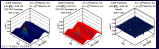
| ZP vs. multiplicity in pp collisions at 13 TeV
|

|
| ZN vs. multiplicity in pp collisions at 13 TeV
|

|
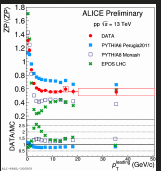
| ZP vs. leading pT
|
|
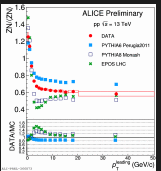
| ZN vs. leading pT
|
|
| ZN spectrum in multiplicity bins in pp collisions at 13 TeV: ratio to MB
|

|
| ZN spectrum in multiplicity bins in pp collisions at 13 TeV
|

|
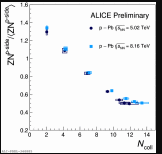
| p-side ZN signal vs. Ncoll in p-Pb collisions
|
|
| p-side ZN signal vs. centrality in p-Pb collisions
|

|
| Pb-side ZN signal vs. centrality in p-Pb collisions
|

|
| ZDC asymmetry in multiplicity bins in pp collisions at 13 TeV
|

|
| ZN and ZP asymmetry in pp collisions at 13 TeV
|

|
| Very forward energy vs. multiplicity measured at midrapidity in pp and p-Pb collisions
|

|
| ZDCA vs. ZDCC in pp collisions at 13 TeV
|

|
| ZPA vs. ZPC in pp collisions at 13 TeV
|

|
| ZNA vs. ZNC in pp collisions at 13 TeV
|

|
| The TPC-TPC correlation and related fit in 1.5< \it{p}_{\rm T}(trig)<2 GeV/\it{c}, 0.5< \it{p}_{\rm T}(assoc)<5 GeV/\it{c}
|

|
| Likelihood fit projections on invariant mass and pseudoproper decay length distributions (4 < pT < 5 GeV/c)
|

|
| Fraction of J/ψ from beauty hadron decays in p-Pb collisions at 8.16 TeV in comparison with p-Pb measurements
|

|
| Fraction of J/ψ from beauty hadron decays in p-Pb collisions at 8.16 TeV in comparison with pp measurements
|

|
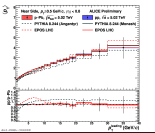
Average-pT in NS-TS (Near Side/towards region) for track pT > 0.5GeV/c in pp and pPb collisions at sqrt(s) = 5.02 TeV.
- PWG : PWG-MM (Monte Carlo generators and Minimum Bias)
- Energy: 5.02 TeV
- System p-p ,
- System p-Pb
|
|
Average-pT in AS-TS (Away Side/region) for track pT > 0.5GeV/c in pp and pPb collisions at sqrt(s) = 5.02 TeV.
- PWG : PWG-MM (Monte Carlo generators and Minimum Bias)
- Energy: 5.02 TeV
- System p-p ,
- System p-Pb
|

|
Charged-particle sum-pT density in AS-TS (Away Side/region) for track pT > 0.5GeV/c in pp and pPb collisions at sqrt(s) = 5.02 TeV
- PWG : PWG-MM (Monte Carlo generators and Minimum Bias)
- Energy: 5.02 TeV
- System p-p ,
- System p-Pb
|

|
Charged-particle sum-pT density in NS-TS (Near Side/towards region) for track pT > 0.5GeV/c in pp and pPb collisions at sqrt(s) = 5.02 TeV
- PWG : PWG-MM (Monte Carlo generators and Minimum Bias)
- Energy: 5.02 TeV
- System p-p ,
- System p-Pb
|

|
Charged-particle density in AS-TS (Away Side/region) for track pT > 0.5GeV/c in pp and pPb collisions at sqrt(s) = 5.02 TeV
- PWG : PWG-MM (Monte Carlo generators and Minimum Bias)
- Energy: 5.02 TeV
- System p-p ,
- System p-Pb
|

|
Charged-particle density in NS-TS (Near Side/towards region) for track pT > 0.5GeV/c in pp and pPb collisions at sqrt(s) = 5.02 TeV
- PWG : PWG-MM (Monte Carlo generators and Minimum Bias)
- Energy: 5.02 TeV
- System p-p ,
- System p-Pb
|

|
Charged-particle sum-pT density in Near Side (Toward region) for track pT > 0.5GeV/c in pPb collisions at sqrt(s) = 5.02 TeV
- PWG : PWG-MM (Monte Carlo generators and Minimum Bias)
- Energy: 5.02 TeV
- System p-p ,
- System p-Pb
|

|
Charged-particle sum-pT density in Transverse Side/region for track pT > 0.5GeV/c in pPb collisions at sqrt(s) = 5.02 TeV
- PWG : PWG-MM (Monte Carlo generators and Minimum Bias)
- Energy: 5.02 TeV
- System p-p ,
- System p-Pb
|

|
Charged-particle sum-pT density in Away Side/region for track pT > 0.5GeV/c in pPb collisions at sqrt(s) = 5.02 TeV
- PWG : PWG-MM (Monte Carlo generators and Minimum Bias)
- Energy: 5.02 TeV
- System p-p ,
- System p-Pb
|

|
Charged-particle sum-pT density in Transverse Side/region for track pT > 0.5GeV/c in pp collisions at sqrt(s) = 5.02 TeV
- PWG : PWG-MM (Monte Carlo generators and Minimum Bias)
- Energy: 5.02 TeV
- System p-p ,
- System p-Pb
|

|
Charged-particle sum-pT density in Away Side/region for track pT > 0.5GeV/c in pp collisions at sqrt(s) = 5.02 TeV
- PWG : PWG-MM (Monte Carlo generators and Minimum Bias)
- Energy: 5.02 TeV
- System p-p ,
- System p-Pb
|

|
Charged-particle sum-pT density in Near Side (Toward region) for track pT > 0.5GeV/c in pp collisions at sqrt(s) = 5.02 TeV
- PWG : PWG-MM (Monte Carlo generators and Minimum Bias)
- Energy: 5.02 TeV
- System p-p ,
- System p-Pb
|

|
Charged-particle density in Transverse Side/region for track pT > 0.5GeV/c in pPb collisions at sqrt(s) = 5.02 TeV
- PWG : PWG-MM (Monte Carlo generators and Minimum Bias)
- Energy: 5.02 TeV
- System p-p ,
- System p-Pb
|

|
Charged-particle density in Away Side/region for track pT > 0.5GeV/c in pPb collisions at sqrt(s) = 5.02 TeV
- PWG : PWG-MM (Monte Carlo generators and Minimum Bias)
- Energy: 5.02 TeV
- System p-p ,
- System p-Pb
|

|
Charged-particle density in Near Side (towards region) for track pT > 0.5GeV/c in pPb collisions at sqrt(s) = 5.02 TeV
- PWG : PWG-MM (Monte Carlo generators and Minimum Bias)
- Energy: 5.02 TeV
- System p-p ,
- System p-Pb
|

|
Charged-particle density in Transverse Side/region for track pT > 0.5GeV/c in pp collisions at sqrt(s) = 5.02 TeV
- PWG : PWG-MM (Monte Carlo generators and Minimum Bias)
- Energy: 5.02 TeV
- System p-p ,
- System p-Pb
|

|
Charged-particle density in Near Side (towards region) for track pT > 0.5GeV/c in pp collisions at sqrt(s) = 5.02 TeV
- PWG : PWG-MM (Monte Carlo generators and Minimum Bias)
- Energy: 5.02 TeV
- System p-p ,
- System p-Pb
|

|
Charged-particle density in Away Side/region for track pT > 0.5GeV/c in pp collisions at sqrt(s) = 5.02 TeV
- PWG : PWG-MM (Monte Carlo generators and Minimum Bias)
- Energy: 5.02 TeV
- System p-p ,
- System p-Pb
|

|
| Pseudorapidity distributions of photons compared with Charged particle measurements at Mid-rapidity in p-Pb collisions at $\sqrt{s\rm_{NN}}$ = 5.02 TeV
|

|
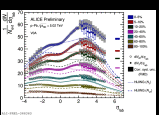
| Centrality dependent Pseudorapidity distributions of photons compared with HIJING in p-Pb collisions at $\sqrt{s\rm_{NN}}$ = 5.02 TeV
|
|
| Centrality dependent Pseudorapidity distributions of photons compared with DPMJET in p-Pb collisions at $\sqrt{s\rm_{NN}}$ = 5.02 TeV
|

|
| Centrality dependent Pseudorapidity distributions of photons in p-Pb collisions at $\sqrt{s\rm_{NN}}$ = 5.02 TeV
|

|
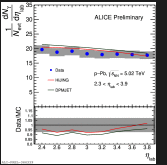
| Pseudorapidity distributions of photons in p-Pb collisions at $\sqrt{s\rm_{NN}}$ = 5.02 TeV
|
|
| Multiplicity distribution of photons in p-Pb collisions at $\sqrt{s\rm_{NN}}$ = 5.02 TeV
|

|
| Normalised Delta v3 of pions
|

|
| Normalised Delta v2 of pions
|

|
| Normalised Delta v3 of hadrons
|

|
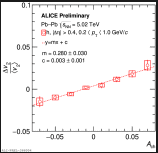
| Normalised Delta v2 of hadrons
|
|
| v3vsAch of pions
|

|
| v2vsAch of pions
|

|
| v3vsAch of hadrons
|
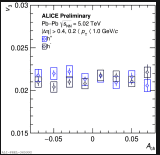
|
| v2vsAch of hadrons
|

|
| Normalisedv3slope comparison of hadrons between ALICE and CMS
|

|
| Normalisedv2slope comparison of hadrons between ALICE and CMS
|

|
| Normalisedv3slope comparison of pions between ALICE and STAR
|

|
| Normalisedv2slope comparison of pions between ALICE and STAR
|

|
| Normalisedv3slope comparison of pions with hadrons
|
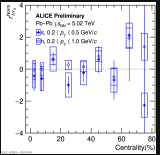
|
| Normalisedv2v3slope comparison of pions
|

|
| Normalisedv2v3slope comparison of hadrons
|

|
| \Delta\varphi Projection of h-K^0_S - MC comparison
|

|
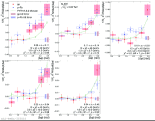
| Isolated photon-hadron correlation functions in pp and p–Pb at sqrt(s) = 5.02 TeV, remaining zT bins
|
|
| Signal region and background region correlation function comparison in p–Pb at sqrt(s) = 5.02 TeV
|

|
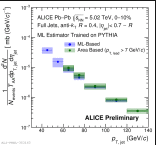
| ML Pb--Pb Spectrum R = 0.4, 0-10%, Compared to AB method
|
|
| R=0.2 Uncorrected (raw) hadron+jet $\Delta_{recoil}$ vs $\Delta\phi$ distributions for $30 < p_{\mathrm{T,jet}^{ch}} < 40$ GeV/c in 0-10% Pb-Pb collisions at $\sqrt{\it{s}_{NN}} = 5.02$ TeV
|

|
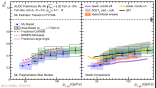
| ML Raa Fragmentation Bias Curves with Model Comparisons R = 0.4, 0-10%
|
|
| ML Full Jet Raa, R = 0.4, 0-10%
|

|
| ML Pb--Pb Full Jet Spectrum R = 0.4, 0-10%
|

|
| ML Raa with Fragmentation Bias Curves
|

|
| Acceptance-times-efficiency for J/psi as function of CosTheta and Centrality in the Helicity reference frame
|

|
| Fit to the corrected J/psi distribution as a function of cosTheta in 0-20% and 60-90% centrality classes
|

|
| Fit to the J/psi distribution as a function of cosTheta for 0-20% and 60-90% centrality classes
|

|
Self normalization yield of omega-meson at 6.0-8.0 GeV/c at forward-rapidity (2.5<y<4.0) as a function of the charged particle multiplicity at mid-rapidity (|\eta|<1.0) compared with Pythia8 predictions (Color rope + hadronic rescattering)
- Fig. Group : Low mass dimuons
- PWG : PWG-LF (Light Flavour Spectra)
- Energy: 13 TeV
- System p-p
|

|
Self normalization yield of omega-meson at 2.5-3.0 GeV/c at forward-rapidity (2.5<y<4.0) as a function of the charged particle multiplicity at mid-rapidity (|\eta|<1.0) compared with Pythia8 predictions (Color rope + hadronic rescattering)
- Fig. Group : Low mass dimuons
- PWG : PWG-LF (Light Flavour Spectra)
- Energy: 13 TeV
- System p-p
|

|
Self normalization yield of omega-meson at 0.5-1.0 GeV/c at forward-rapidity (2.5<y<4.0) as a function of the charged particle multiplicity at mid-rapidity (|\eta|<1.0) compared with Pythia8 predictions (Color rope + hadronic rescattering)
- Fig. Group : Low mass dimuons
- PWG : PWG-LF (Light Flavour Spectra)
- Energy: 13 TeV
- System p-p
|

|
Self normalization yield of phi-meson at 6.0-8.0 GeV/c at forward-rapidity (2.5<y<4.0) as a function of the charged particle multiplicity at mid-rapidity (|\eta|<1.0) compared with Pythia8 predictions (Color rope + hadronic rescattering)
- Fig. Group : Low mass dimuons
- PWG : PWG-LF (Light Flavour Spectra)
- Energy: 13 TeV
- System p-p
|

|
Self normalization yield of phi-meson at 2.5-3.0 GeV/c at forward-rapidity (2.5<y<4.0) as a function of the charged particle multiplicity at mid-rapidity (|\eta|<1.0) compared with Pythia8 predictions (Color rope + hadronic rescattering)
- Fig. Group : Low mass dimuons
- PWG : PWG-LF (Light Flavour Spectra)
- Energy: 13 TeV
- System p-p
|

|
Self normalization yield of phi-meson at 0.5-1.0 GeV/c at forward-rapidity (2.5<y<4.0) as a function of the charged particle multiplicity at mid-rapidity (|\eta|<1.0) compared with Pythia8 predictions (Color rope + hadronic rescattering)
- Fig. Group : Low mass dimuons
- PWG : PWG-LF (Light Flavour Spectra)
- Energy: 13 TeV
- System p-p
|

|
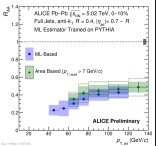
| ML Full Jet Raa Compared to Area-Based Raa, R=0.4, 10%
|
|
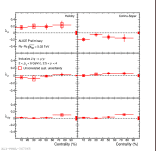
| lambda_Theta, lambda_Phi, lambda_ThetaPhi vs centrality in Pb-Pb collisions at sqrt(s_NN) = 5.02 TeV, in the Helicity and Collins-Soper reference frames
|
|
Self normalization yield of omega-meson at 6.0-8.0 GeV/c at forward-rapidity (2.5<y<4.0) as a function of the charged particle multiplicity at mid-rapidity (|\eta|<1.0) compared with Pythia8 predictions
- Fig. Group : Low mass dimuons
- PWG : PWG-LF (Light Flavour Spectra)
- Energy: 13 TeV
- System p-p
|

|
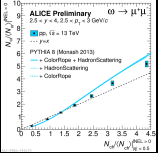
Self normalization yield of omega-meson at 2.5-3.0 GeV/c at forward-rapidity (2.5<y<4.0) as a function of the charged particle multiplicity at mid-rapidity (|\eta|<1.0) compared with Pythia8 predictions
- Fig. Group : Low mass dimuons
- PWG : PWG-LF (Light Flavour Spectra)
- Energy: 13 TeV
- System p-p
|
|
Self normalization yield of omega-meson at 0.5-1.0 GeV/c at forward-rapidity (2.5<y<4.0) as a function of the charged particle multiplicity at mid-rapidity (|\eta|<1.0) compared with Pythia8 predictions
- Fig. Group : Low mass dimuons
- PWG : PWG-LF (Light Flavour Spectra)
- Energy: 13 TeV
- System p-p
|

|
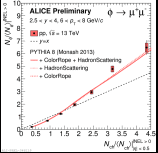
Self normalization yield of phi-meson at 6.0-8.0 GeV/c at forward-rapidity (2.5<y<4.0) as a function of the charged particle multiplicity densities at mid-rapidity (|\eta|<1.0)
- Fig. Group : Low mass dimuons
- PWG : PWG-LF (Light Flavour Spectra)
- Energy: 13 TeV
- System p-p
|
|
Self normalization yield of phi-meson at 2.5-3.0 GeV/c at forward-rapidity (2.5<y<4.0) as a function of the charged particle multiplicity densities at mid-rapidity (|\eta|<1.0)
- Fig. Group : Low mass dimuons
- PWG : PWG-LF (Light Flavour Spectra)
- Energy: 13 TeV
- System p-p
|

|
Self normalization yield of phi-meson at 0.5-1.0 GeV/c at forward-rapidity (2.5<y<4.0) as a function of the charged particle multiplicity at mid-rapidity (|\eta|<1.0) compared with Pythia8 predictions
- Fig. Group : Low mass dimuons
- PWG : PWG-LF (Light Flavour Spectra)
- Energy: 13 TeV
- System p-p
|

|
pT spectra of omega-meson in pp collisions in SPDTrk multiplicity classes and Ratios to INEL>0 with SPDTrk percentile
- Fig. Group : Low mass dimuons
- PWG : PWG-LF (Light Flavour Spectra)
- Energy: 13 TeV
- System p-p
|

|
pT spectra of phi-meson in pp collisions in SPD Trk multiplicity classes and Ratios to INEL>0 with SPDTrk percentile
- Fig. Group : Low mass dimuons
- PWG : PWG-LF (Light Flavour Spectra)
- Energy: 13 TeV
- System p-p
|

|
| Ipp, IpA and IAA as a function of average multiplicity in transverse region for near side in pp, p-Pb and Pb-Pb collisions at 5.02 TeV
|

|
| vn of inclusive and identified particles for unbiased, 0-10% and 90-100% qn classes for 5-10% and 30-40% centrality classes in Pb-Pb collisions
|

|
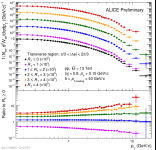
| Transverse pT spectra
|
|
| Scaled width of the V0 asymmetry distribution as a function of V0M/<V0M> in pp 13 TeV
|

|
| Mean V0M asymmetry as a function of V0M/<V0M> for different event bias in pp 13 TeV
|

|
| V0M asymmetry distributions in bins of V0M/<V0M> in pp 13 TeV for TT{6,7}
|

|
| V0M asymmetry distributions in bins of V0M/<V0M> in pp 13 TeV
|

|
| V0M/<V0M> distribution as measured by ALICE in high multiplicity pp 13 TeV in 2016, 2017 and 2018
|

|