
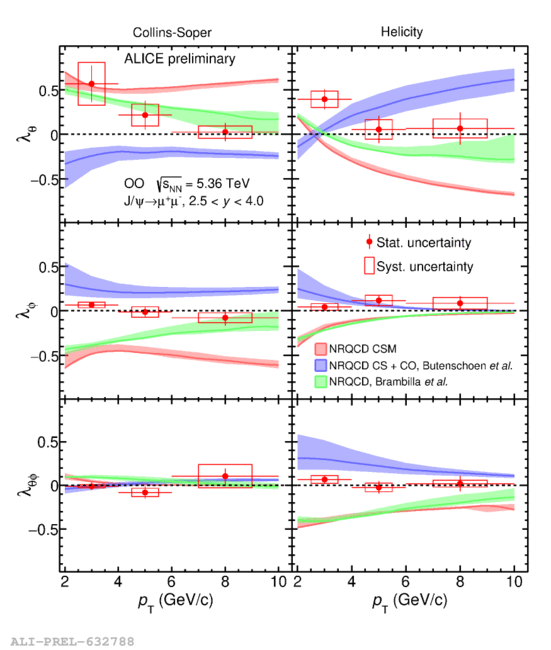
Comparison $\lambda_{\theta}$, $\lambda_{\phi}$, $\lambda_{\theta \phi}$ polarization parameters for J/\psi as a function of p_{\rm T} in OO collisions at 5.36 TeV with different NRQCD model predictions measured at forward rapidity (2.5 < y < 4.0).
Data Sample: LHC25ae pass2
MC: LHC25i4 (anchored to LHC25ae pass2)
Event Cuts: EventSel8
Track Cut: matchedMchMid
The details about the model predictions are given below:
These are NRQCD model predictions for oxygen-oxygen collisions at 5.02 TeV measured at forward rapidity(2.5 < y < 4.0). These were
produced using the nCTEQ nuclear PDFs in heavy-ion collisions . Particularly the used PDF set is nCTEQ15HQ_FullNuc_16_8 (16_8 for the
oxygen nucleus). The nCTEQ15HQ has two advantages for Quarkonium calculation: First they use the CTEQ6M proton PDFs as a baseline for the
nuclear PDF fit, which is in line with both the Butenschoen et al. and the Brambilla et al. LDME fits, so there is no incompatibility. And
secondly, for this particular nuclear PDF fit, Quarkonium production data has been included in their fits to heavy ion data, using a
Crystal-Ball function (i.e. independent of concrete quarkonium production models) for the proton-proton Quarkonium production cross
sections, and that fit worked very well. Therefore, we know that all in medium effects at least for unpolarized quarkonium production are
effectively reproduced by this nuclear PDF set.
So these are valid polarization predictions based on NRQCD for oxygen-oxygen collisions using the nCTEQ15HQ nPDFs, and the LDMEs given
in the Butenschoen et al. and Brambilla et al. fits, where, of course, all of these models have their limitations.
In addition, it is important to note that QGP medium effects are not included in the OO model calculation, but the Cold Nuclear matter effects are included in the model. Because there is no solid calculation of the effect of the QGP on the J/psi polarization yet in heavy-ion collisions and but comparing the OO measureemnt with the calculation that include initial nuclear effect is extremely interesting! The observed difference beteween data and compared model could come from the QGP effect on the J/psi polarization.