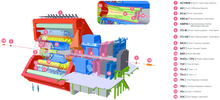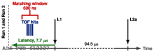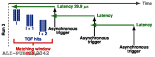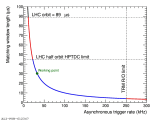
Figures from paper submitted to European Physical Journal Plus
Abstract:
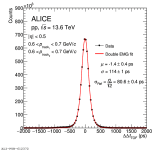
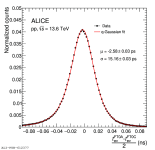
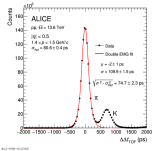
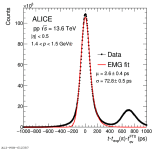
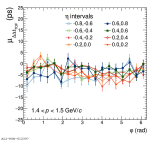
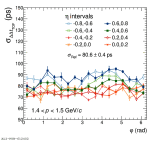
Particle identification (PID) is a fundamental aspect of the ALICE detector system, central to its heavy-ion and proton-proton physics programs. Among the different PID strategies, ALICE uses the Time-Of-Flight (TOF) detector to identify particles at intermediate momenta ($0.5 <~ p_{\rm T} <~ 4$ GeV/$c$). The ALICE TOF detector performed successfully during the first ten years of LHC operations. During the Long Shutdown 2, many ALICE sub-detectors, including TOF, were upgraded to fully leverage the targeted 50 kHz interaction rate of Pb-Pb collisions, which required the implementation of a continuous readout scheme. The TOF detector electronics were upgraded and refurbished, while processing algorithms for data quality control, reconstruction, calibration, and analysis were rewritten. This paper presents the upgraded TOF detector operation and calibration procedures and its performance in terms of timing resolution, a key factor for particle separation in ALICE analyses. Using 2022 pp collision data at $\sqrt{s} = 13.6$ TeV from Run 3, the time resolution of the detector was estimated with two independent methods, both yielding consistent results, better than 80 ps. Despite the excellent performance already achieved, further improvements are expected after additional detector commissioning and refined calibration procedures, thus enhancing the ALICE PID capabilities for Run 3 and beyond.
e-Print: arXiv:2511.10311 | PDF | inSPIRE