
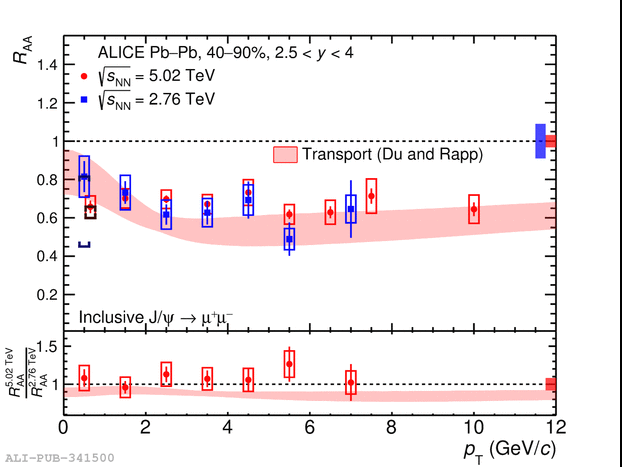
p.p1 {margin: 0.0px 0.0px 0.0px 0.0px; font: 12.0px 'Helvetica Neue'; min-height: 14.0px} p.p2 {margin: 0.0px 0.0px 0.0px 0.0px; font: 12.0px 'Helvetica Neue'} Inclusive J/ψ nuclear modification factor as a function of pT for Pb–Pb collisions at \sqrt{s_{NN}}= 5.02 TeV , in the 40–90% centrality class. The vertical error bars represent statistical uncertainties, the boxes around the points uncorrelated systematic uncertainties, while the correlated uncertainty is shown as a filled box around RAA = 1. The corresponding measurements in Pb–Pb collisions at 2.76 TeV are also shown, as well as the ratio of the RAA values, which is depicted in the bottom panel of the figure. The RAA values at \sqrt{s_{NN}}= 5.02 TeV and the ratios to lower energy results are compared with transport model calculations. The brackets around RAA values for in the lowest pT interval represent an estimate of the influence of J/ψ photo-production.
Inclusive J/ψ nuclear modification factor as a function of pT for Pb–Pb collisions at \sqrt{s_{NN}}= 5.02 TeV , in the 40–90% centrality class. The vertical error bars represent statistical uncertainties, the boxes around the points uncorrelated systematic uncertainties, while the correlated uncertainty is shown as a filled box around RAA = 1. The corresponding measurements in Pb–Pb collisions at 2.76 TeV are also shown, as well as the ratio of the RAA values, which is depicted in the bottom panel of the figure. The RAA values at \sqrt{s_{NN}}= 5.02 TeV and the ratios to lower energy results are compared with transport model calculations. The brackets around RAA values for in the lowest pT interval represent an estimate of the influence of J/ψ photo-production.